
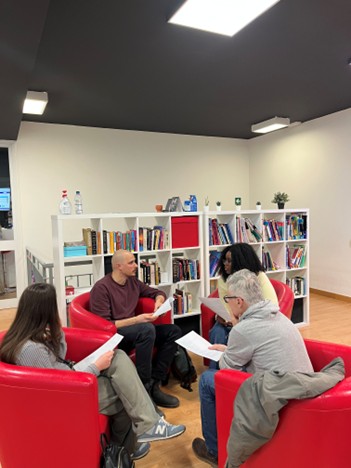
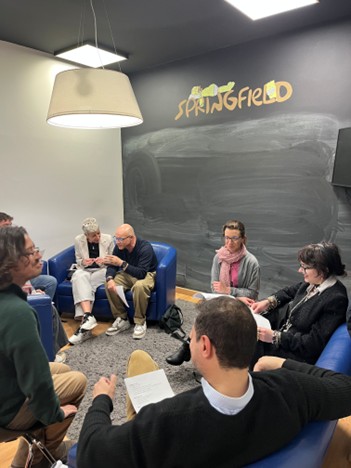
Our language exchange program—revived this semester and rebranded with the special name TALKISSIMO—continues to offer students a way to engage with language beyond the classroom.
On paper, Talkissimo is a language exchange. In practice, it rarely stays that simple.
The program brings together Syracuse students studying Italian with local learners working on their English. They meet, sit down, and start talking. There’s no script to follow for long. Conversations drift, overlap, restart. Italian becomes English, then switches back again. At some point, people stop thinking about which language they’re using.
This semester, the program is carried out in partnership with The British Institute of Florence and My English School, two well-established language schools in the city. Both focus strongly on communication and on creating environments where language is actively spoken and tested in real time. That shared approach helps create a setting where the exchange feels immediate and informal from the start.
What makes Talkissimo effective is its balance. Everyone arrives with something to practice, but also something to offer. Our students are looking for a more direct, less filtered way into Italian, while local participants are equally interested in using their English outside of a classroom setting. The result is a conversation that belongs to both sides.
Just as important is who those conversations happen with. Students don’t only meet peers, but people with different routines, perspectives, and life experiences. Those differences shape the conversation itself, making it less predictable and more substantial than a simple exercise.
Alongside the language itself, it is often the smaller moments that stand out. A word that doesn’t come out right and turns into a joke. A story that takes longer to tell than expected. The kind of laughter that comes from not quite understanding something—and then suddenly getting it.
Over time, these exchanges become part of the rhythm of the semester. By the end, what remains is not only a stronger grasp of the language, but also a series of conversations, voices, and encounters tied to a specific time and place.