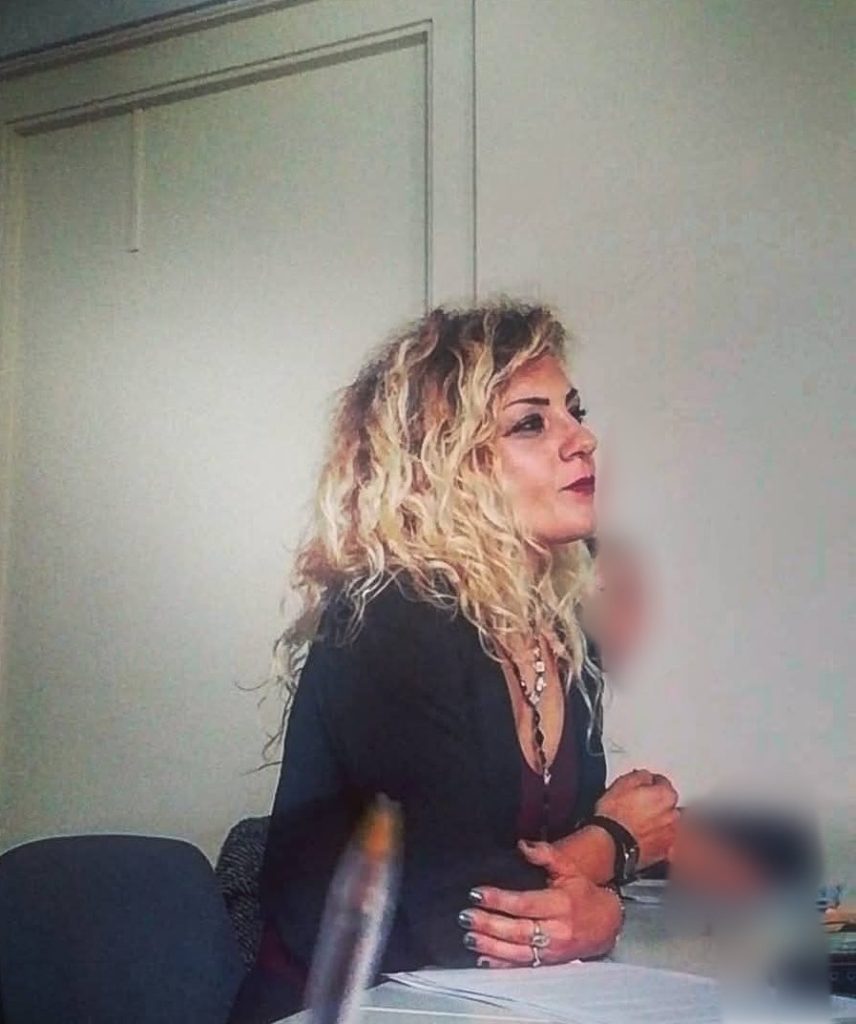
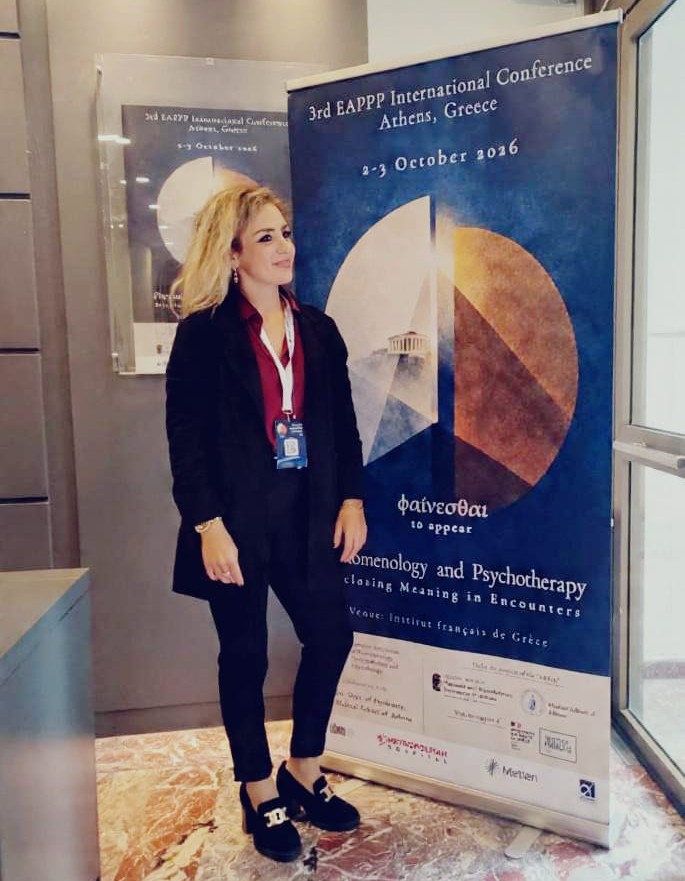
Professor Veronica Iubei, who teaches a course at Syracuse Florence on Italian serial crimes, presented a paper at the 3rd International Conference of the European Association of Phenomenology, Psychopathology and Psychotherapy (EAPPP), held in Athens on 2 and 3 October 2026. The conference was organized under the auspices of the National and Kapodistrian University of Athens and its Medical School, with support from the Institut français de Grèce and the Ambassade de France en Grèce.
Iubei’s paper began with Judith Herman’s landmark book Trauma and Recovery, which argues that people living with Complex PTSD should be seen first and foremost as survivors, not victims or merely patients. “Words matter: they convey a shared ground of reality and meaning,” Iubei said. Recovery and prevention, she argued, must go beyond medication and psychotherapy to engage with broader struggles against power structures and social injustice. Drawing on Ludwig Binswanger’s existential phenomenology, Iubei proposed that the essence of CPTSD lies in the sudden cessation of relationality, a rupture that can be repaired only if the therapist first becomes the survivor’s witness, validating that experience and giving it reality.
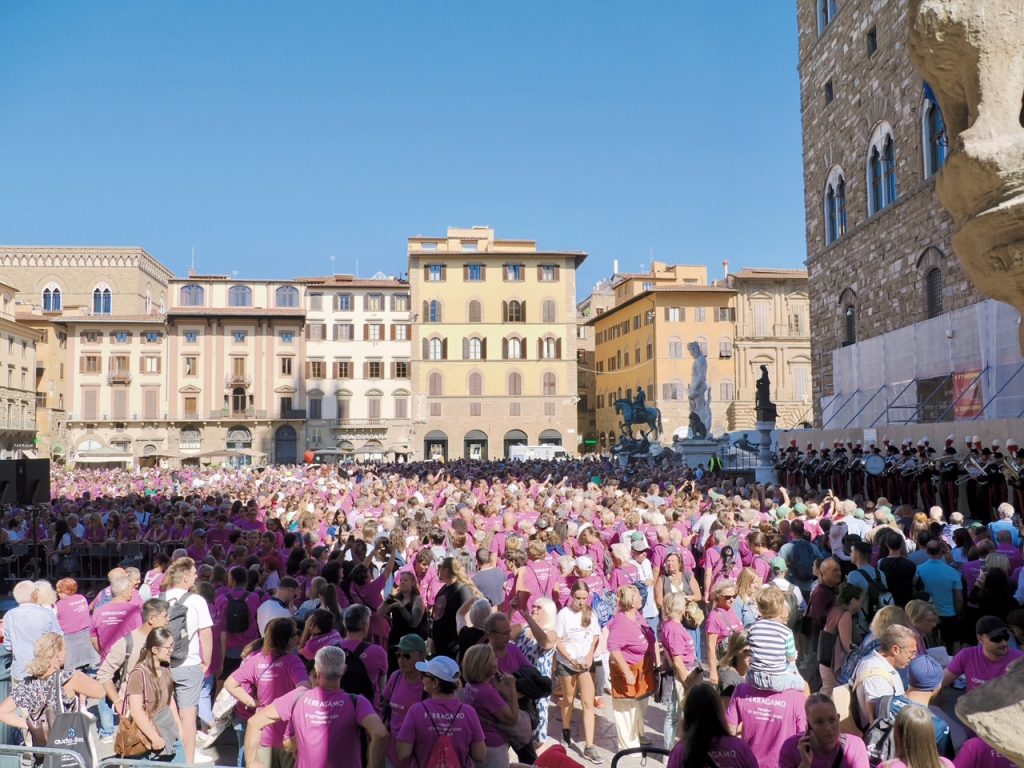
On September 27, 2026, bright pink shirts flooded the streets of Florence, an unstoppable force on a dedicated march to raise money for victims of breast cancer. Over 44,000 people from all over Italy participated in Corri la Vita wearing cyclamen-pink t-shirts, including some our own Syracuse Florence students through the I-Engage program.
Every year, thousands of students, families, children, and even dogs, participate in this fundraising event that began in 2003 by Benoda Frescobaldi to support women affected by breast cancer and fund initiatives related to prevention, early diagnosis, and treatment. Over the past 22 years more than 580,000 people have taken part and raised €10.2 million euros. Participants receive a Ferragamo-designed t-shirt (this year the color was cyclamen pink) by donating at least €10. The fashion company was built in Florence by Salvatore Ferragamo, the “Shoemaker to the Stars” famous for having designed stiletto heels for Marilyn Monroe, and the company is a longtime partner of the yearly charity event. Ferragamo himself died of cancer in 1960, and his daughter, Fiamma, of breast cancer in 1998.
Corri la Vita traditionally has two routes—one 6.2 km long and the other 11 km long—that lead all over Florence, and participants can choose to walk or run. This year, the race began at the Parco delle Cascine and finished at Piazza della Signoria. That day, pink t-shirt wearers were given free access to 68 major cultural destinations in and around the city, including the exclusive chance to discover places normally closed to the public. Highlights included the show BROKEN at Palazzo Strozzi, the Museum of Restoration with the Palazzo Ridolfi Chapel, the Accademia dei Georgofili agricultural museum, and the show OPEN at Palazzo Buontalenti. Prizes were also awarded to the top three race finishers in both the men’s and women’s categories.
Syracuse Florence students have been participating in Corri la Vita since 2007. “For our students, it’s a way to experience Florence from the inside, the way Florentines do, while supporting a cause that matters,” said Internships and Engagement Liaison Olimpia Bozza. She said that participating in the event means truly being part of the Florence experience, as those who join come away with a special memory of the city.
Corri la Vita is a shining example of how Syracuse Florence students can engage with the city of Florence, immersing themselves in the local culture while participating in meaningful volunteer work.
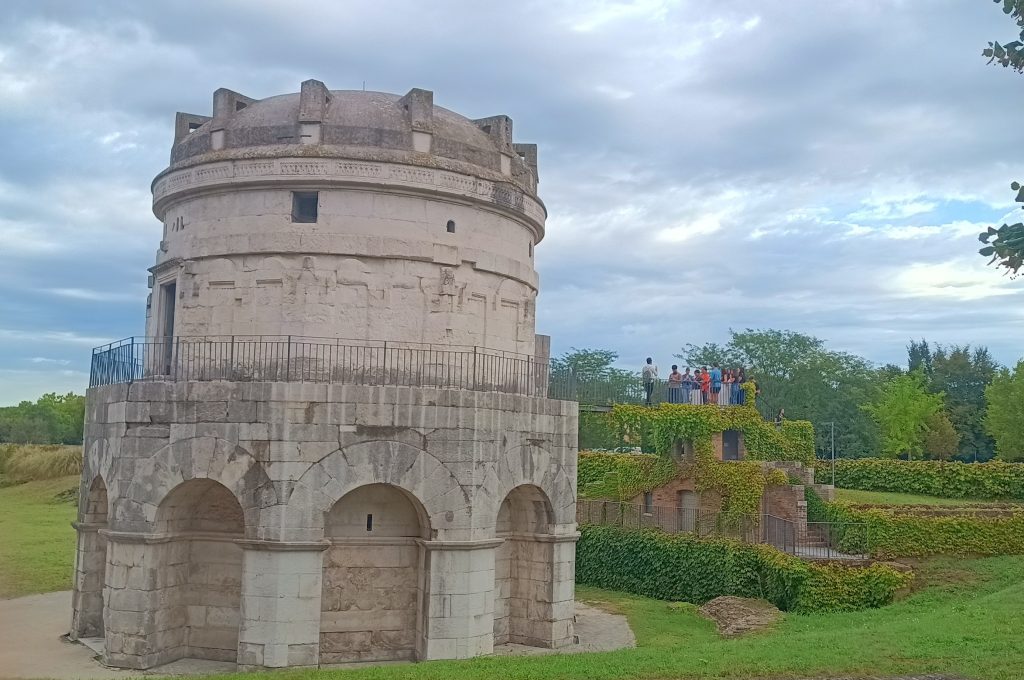
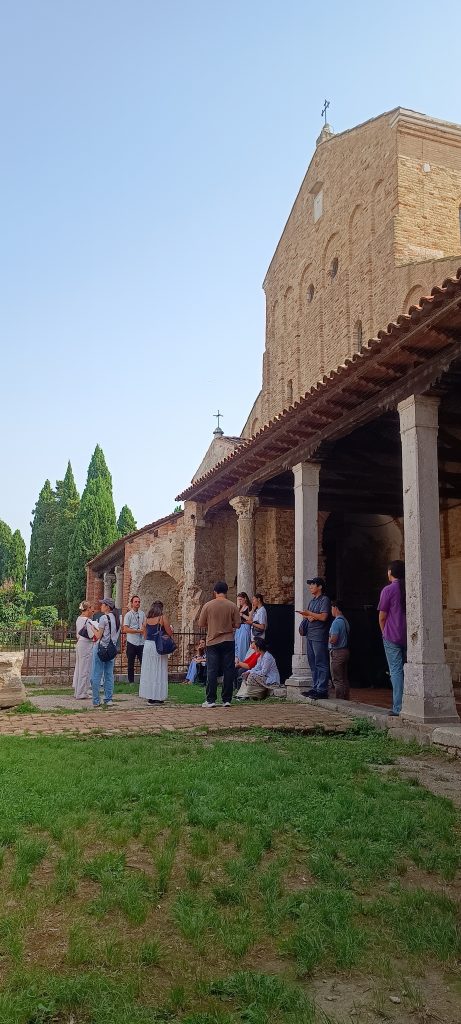
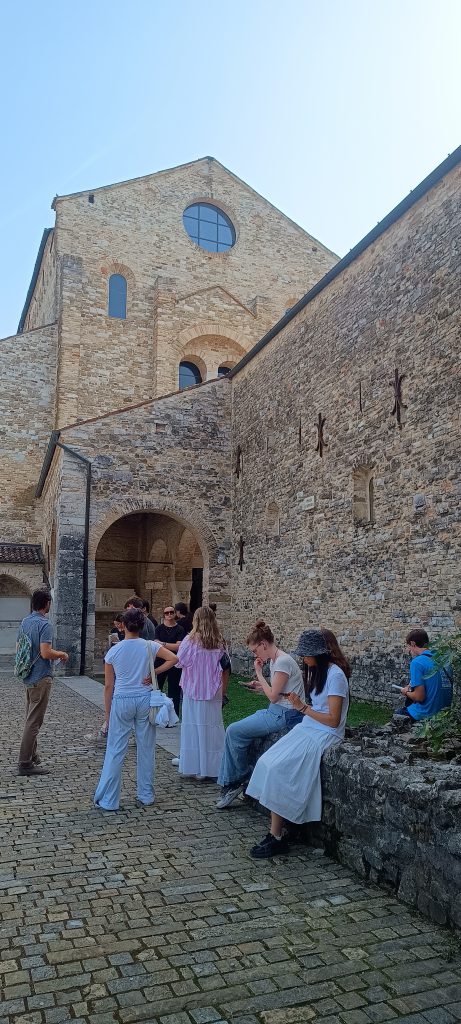
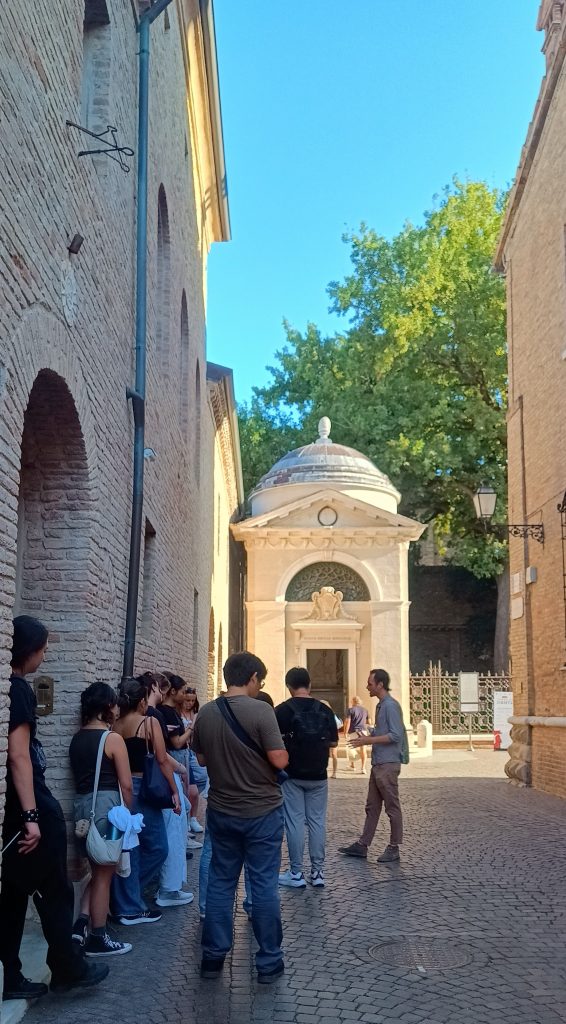
For some students, the semester abroad began before they even reached Florence. An 11-day traveling seminar took them from Ravenna to Venice and into Italy’s northeastern borderlands, where mosaics, monuments, and centuries of cultural exchange became the starting point for their semester.
From August 22 to September 1, students joining Syracuse Florence for Fall 2026 traveled together as part of Empires of Exchange: The Visual Cultures of Power, Mobility, and Erasure in the Mediterranean, a signature seminar led by art history professor Sean Nelson that brought students face-to-face with the works and places they would be studying, using the cities themselves as part of the classroom.
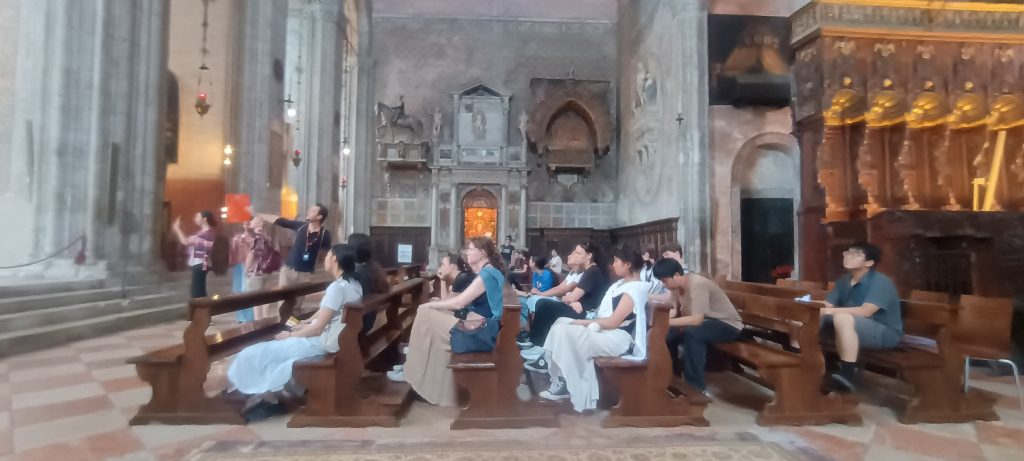
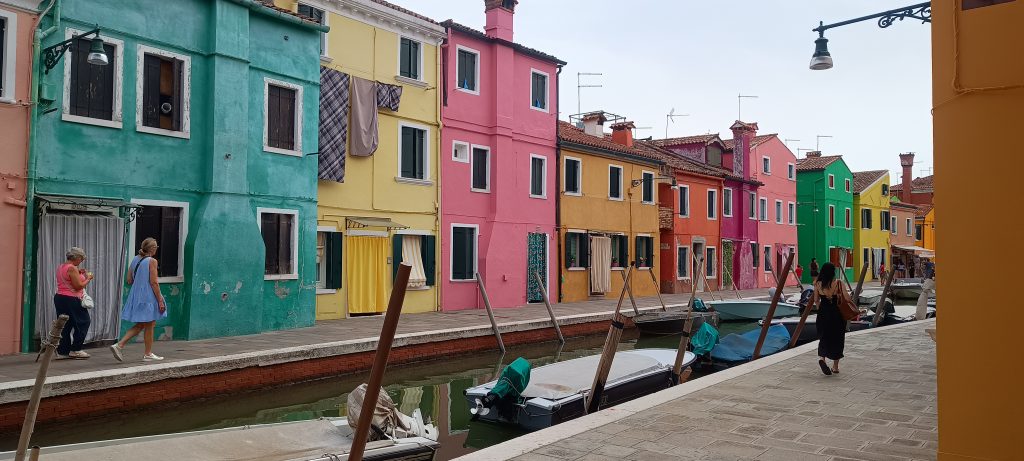
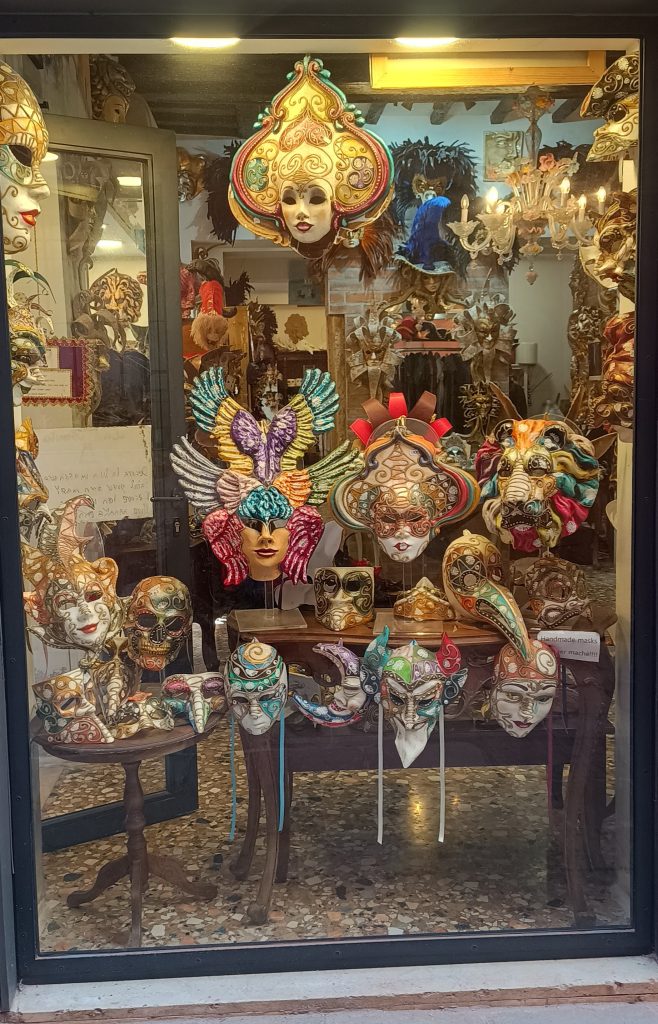
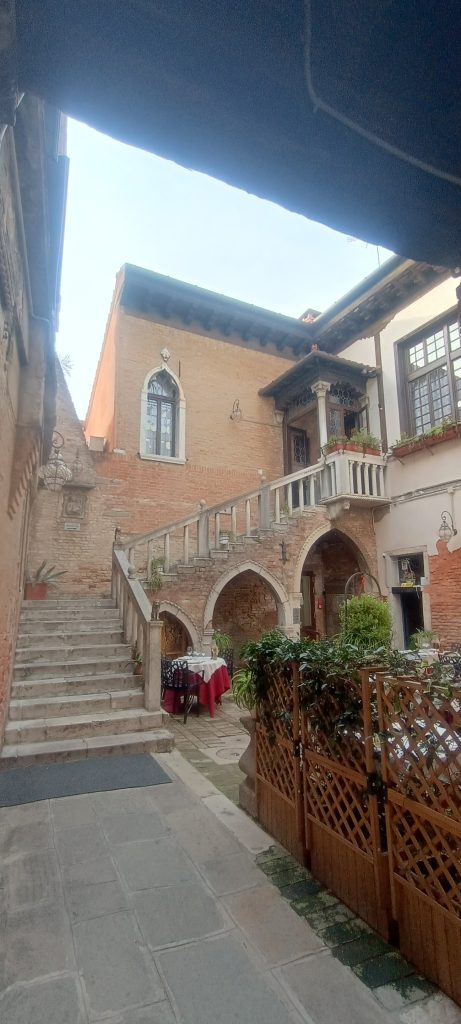
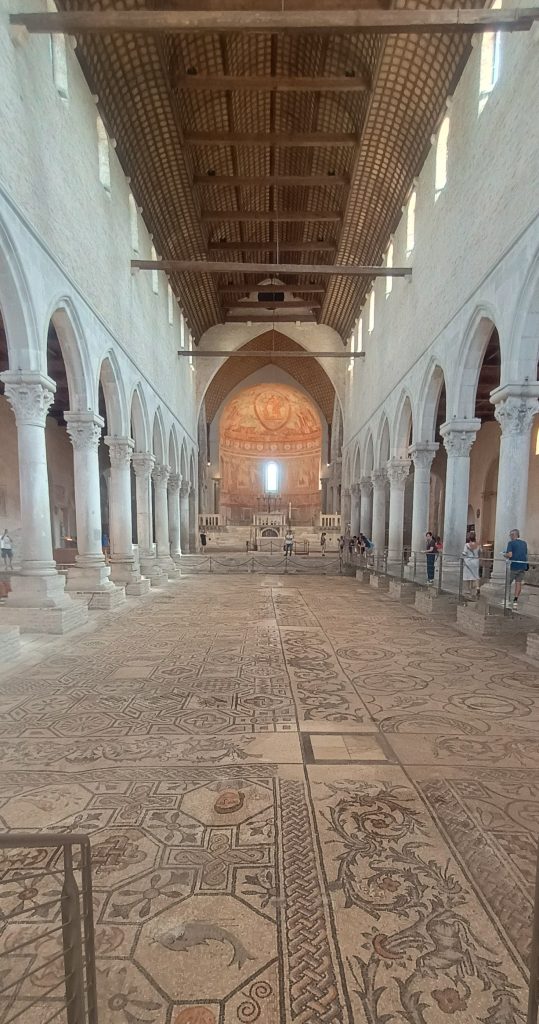
In Ravenna, the group visited the Basilica of San Vitale and its celebrated mosaics. In Venice, students explored the city’s layered history at St. Mark’s Basilica and the Scuola Grande di San Rocco. Visits to Torcello and Aquileia took them farther into the northeastern reaches of the peninsula. “The students visited several sites, traveling the distance the Romans did through time and space, chasing precious works of mosaic,” said Sara Muellner, who assisted Professor Nelson on the trip.
The itinerary reflected the course’s central questions: What happens when cultures meet, borrow from one another, and reshape what came before? How can the art and architecture that was left behind help us understand those encounters?
Students encountered evidence of the many communities that have shaped the region. Roman, Byzantine, Slavic, Arab, Ottoman, Jewish, and Christian influences are part of the visual and cultural history explored throughout the seminar. Students examined how those influences moved across the Mediterranean, how they became part of shared urban spaces, and how some histories became less visible over time.
The course focuses on the Middle Ages and the Early Modern period, roughly the years 1000 to 1700, while also asking students to consider what those histories mean today. Questions of migration, cultural identity, and European political identity remain connected to the histories of the cities and communities the students encountered.
The timing of the seminar made the experience particularly distinctive. Students began their study abroad experience together on the road, visiting major works and historic sites before settling into the classroom. By the time they arrived at the Syracuse Florence Center, they had already covered hundreds of miles and encountered centuries of history firsthand. Their semester began with a journey that had already given them a different way of looking at the country—and at the Mediterranean connections that continue to shape it.
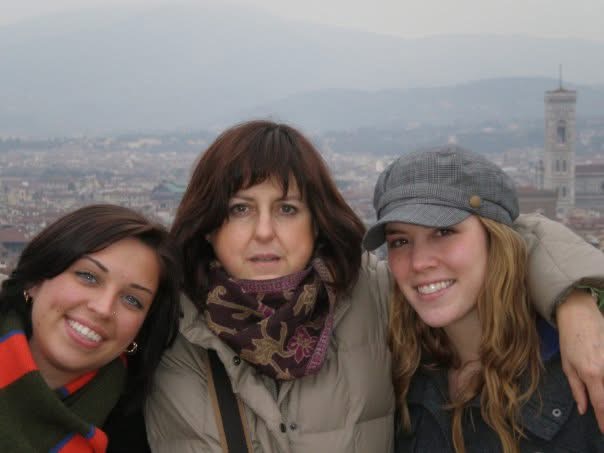
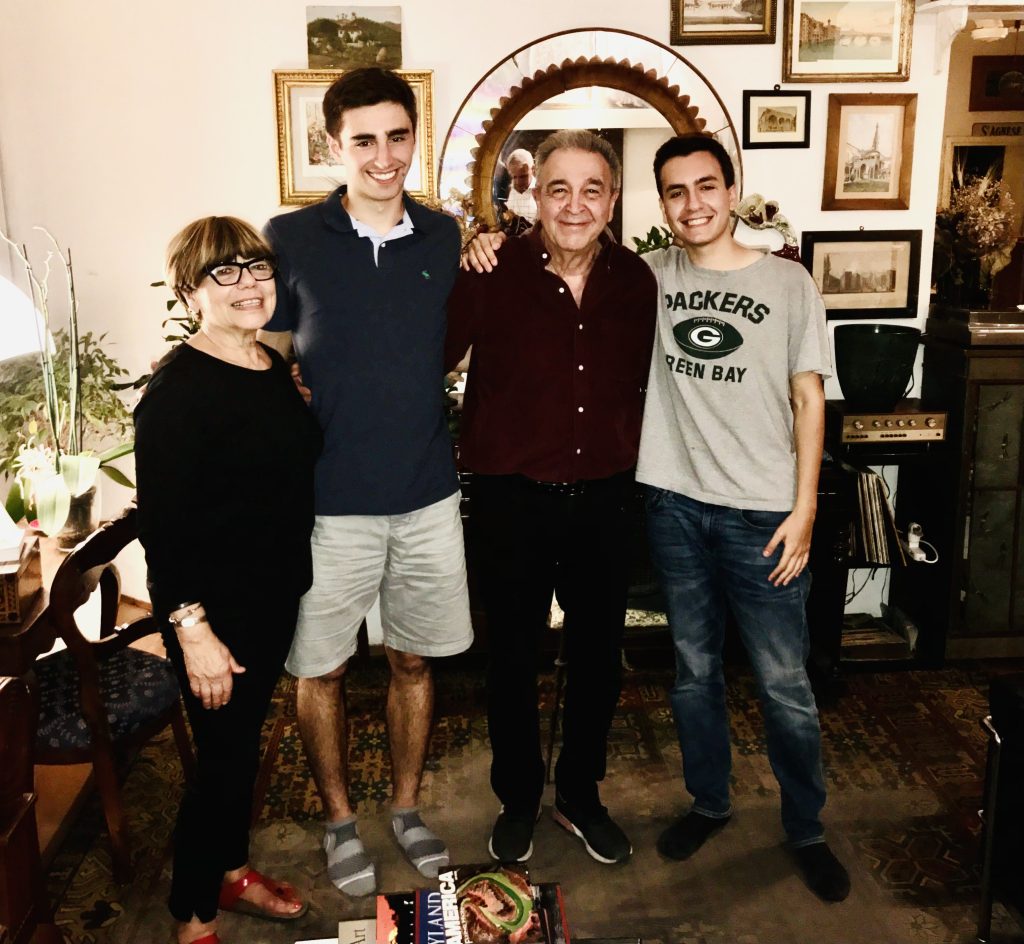
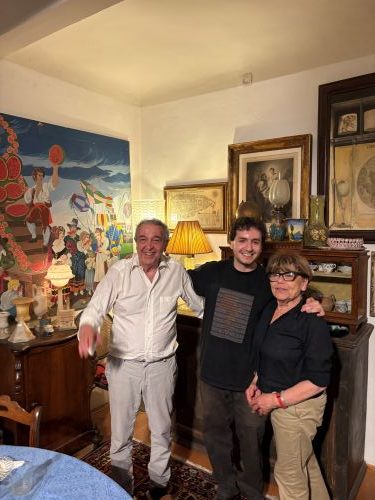
Lauren (left) with host mom Rita Diodori and roommate Jen LaVita Ouellette in Spring 2008
When Lauren arrived in Florence in 2008 as a Syracuse University Italian major, she couldn’t have imagined that nearly two decades later she’d be back — not as a student, but as a professor helping shape the very program that changed her life.
Lauren’s path to Italian started early. Growing up in eastern Pennsylvania with Italian heritage on her mother’s side, she knew from her teens that she wanted to major in Italian and study abroad — even though her high school didn’t offer the language. She chose Syracuse for its size and reputation, and by her first semester on campus she was enrolled in Italian 101, working toward the study abroad experience she’d been dreaming of since she was 16 or 17.
That dream became real when she arrived in Florence and moved in with her host mother, Rita, a widow who lived out past Campo di Marte. In a Florence before smartphones and Wi-Fi, Lauren and her roommate spent long evenings at Rita’s kitchen table, dictionary in hand, trying to explain concepts that don’t translate neatly between languages. “It was really wonderful,” she recalls — one of the formative relationships of her time abroad. Remarkably, Rita is still hosting students today, two decades later.
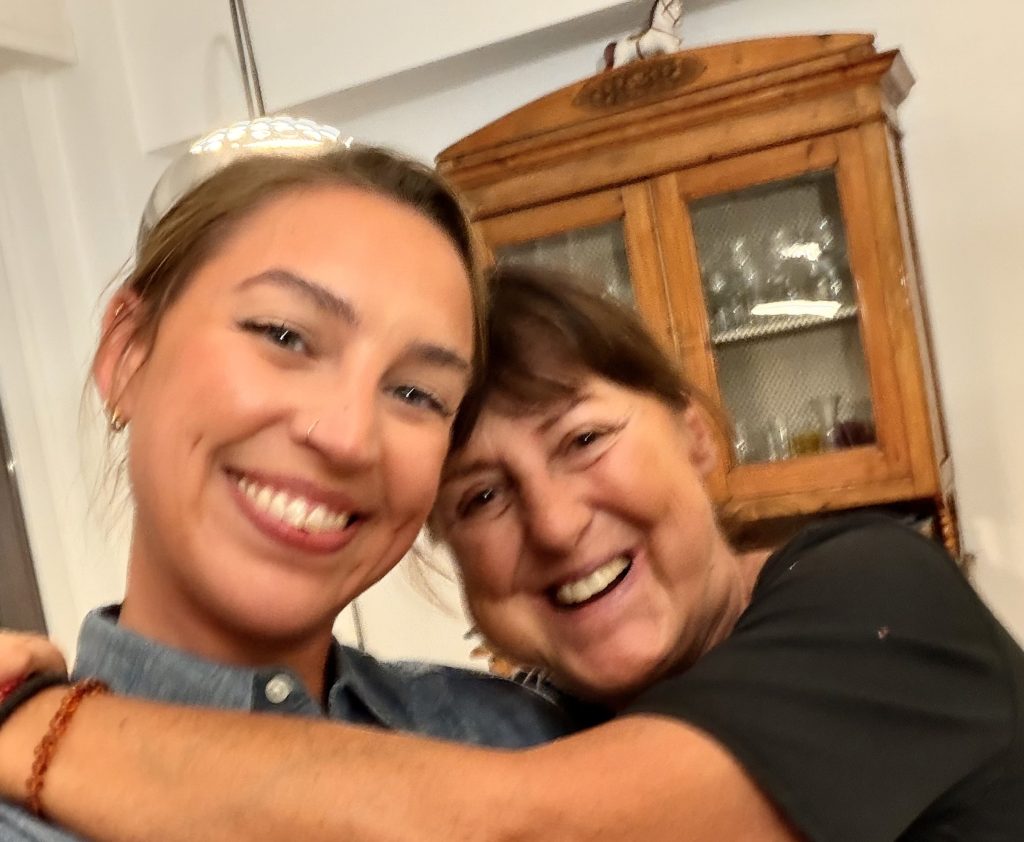
Reuniting in September 2026 with host mom Rita
Like many students, though, Lauren admits she got swept up in the group mentality of her cohort, prioritizing socializing over some of the cultural experiences she’d hoped for. It’s a regret she now shares candidly with her own students: “I wish I spent more time in Florence.” That honesty has become part of what makes her guidance so resonant for the students she advises today.
After graduating in 2009 — into the middle of the financial crash — Lauren spent two years working at a pizzeria before discovering, almost by accident, that graduate study in Italian was even possible. A friend’s Facebook post about being accepted to Middlebury’s Italian master’s program opened a door Lauren didn’t know existed. She enrolled in 2011, spending a second year in Florence — this time, she says, finally finding “her people” among fellow language obsessives in Middlebury’s immersion program.
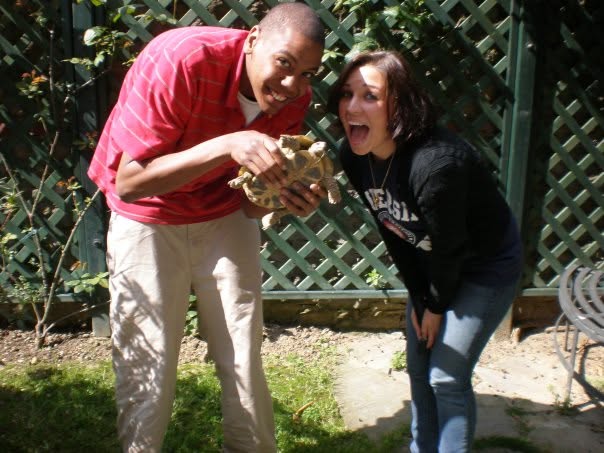
With an SU friend holding one of the Villa Rossa turtles
From there, her academic path led to a PhD in Italian Renaissance literature at the University of Wisconsin–Madison, where she specialized in the comedic works of Machiavelli and Aretino. After finishing her doctorate in 2022, she spent a year teaching humanities in Wisconsin’s prison education system — work she calls some of the most rewarding of her career — before an opportunity arose that would bring her story full circle: a position as Assistant Teaching Professor of Italian at Syracuse University.
Since joining the faculty in January 2023, Lauren has worked to change how students see the Italian major, drawing on her own experience of graduating without a clear sense of career direction. She’s helped redesign the curriculum so students build e-portfolios connecting Italian to their broader career goals — writing Italian resumes and cover letters, and researching how language skills intersect with fields from chemistry to biotech. She’s also brought back alumni roundtables, spotlighting graduates working in finance, e-commerce, and international business, to show current students that fluency in Italian is a professional asset, not just a passion project.
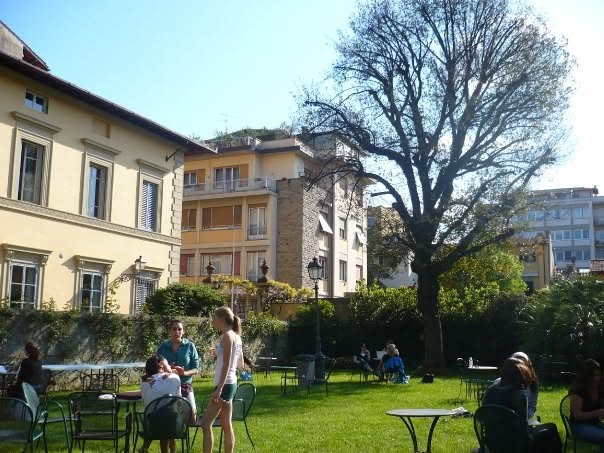
The Villa Rossa garden towards the end of the semester (when it finally gets warm)
Lauren has also become a bridge between Syracuse’s home campus and the Florence program, working closely with the Florence team to strengthen collaboration and bring her own study-abroad experience to bear on student advising — from housing questions to conversations about identity and belonging while abroad.
Looking back, Lauren describes her journey as a series of doors that opened because she said yes — to a study abroad program, a graduate degree she didn’t know existed, a career change, and eventually, a return to the place where it all began. Her advice to current students echoes that same philosophy: seek out opportunities, don’t get swept up in what everyone else is doing, and understand that a semester in Florence can be the first step in a much longer story.
“Every encounter is a door opening,” she says. “Even this little thing that you say yes to opens some door that you have no idea what connection it might make for you.”
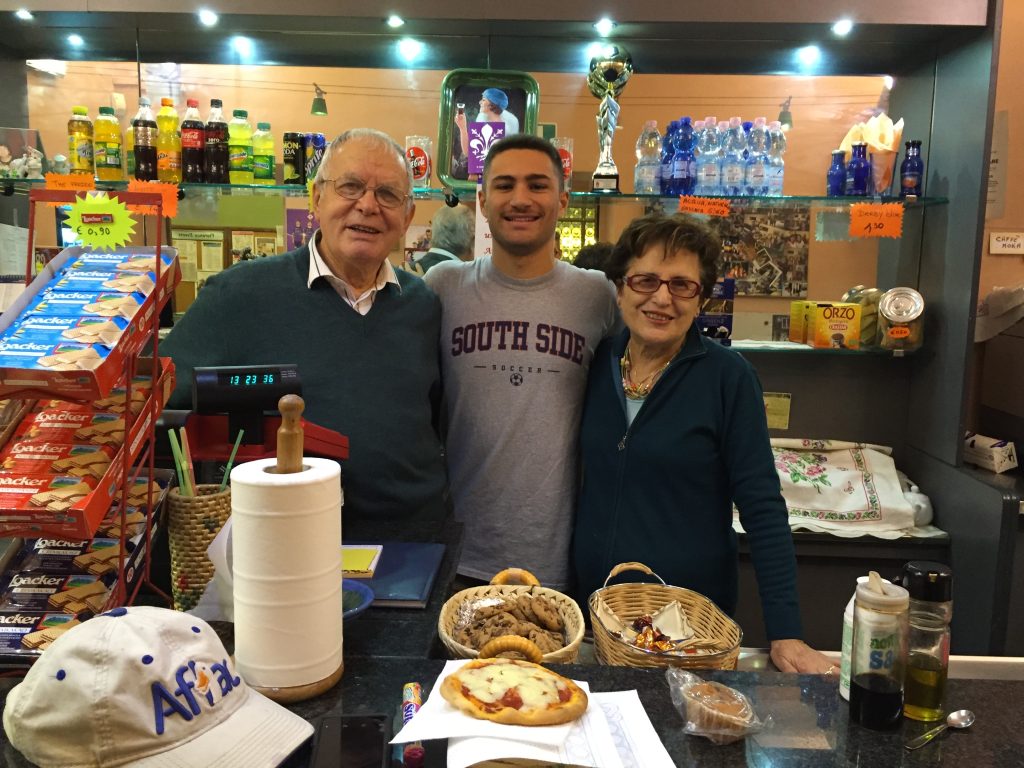
Alessandro Pugliese with the late Sergio Landi and Elia Landi in the “old bar” at Syracuse Florence in Fall 2015
Some students study abroad for a semester and go home with good memories. Alessandro Pugliese studied abroad for a semester — then came back twice more, landed an internship with ACF Fiorentina, and eventually went to work for the club’s owner, Rocco Commisso, back in the United States. Today he’s Manager of Public Relations for Mediacom Communications, the Commisso family business, and he still returns to Florence often enough that it’s less “visiting” and more “coming home.”
Alessandro first arrived at Syracuse Florence as a Discovery student in Fall 2015. As Director Sasha Perugini remembers it, it didn’t take long for him to announce exactly what he wanted: “A first-year student told his marketing professor, Simone Anselmi, MBA, that his dream was to work for Fiorentina, and at the time they weren’t even accepting interns.” Anselmi brought the idea to Perugini, and, as she puts it, “together we figured out how to build a strong Capstone project custom made for this opportunity” — the project that would eventually open Fiorentina’s door to him.
One semester wasn’t enough. Alessandro returned in Fall 2017 as a Discovery Program mentor and again in Spring 2019 for his final undergraduate semester, when he received a certificate of merit from Perugini. He’s since become a fixture around the program: he was recently back in Florence for Fiorentina’s 100th anniversary and, while in town, addressed incoming students during Orientation — in many ways, the ultimate Syracuse Florence success story.
Alessandro alongside two classmates who also returned to Florence Junior Year, their Discovery mentees, and Professor Amy Kleine, in Fall 2017
Two Internships, One Owner
“The internship with Fiorentina was in Fall 2017, and funny enough, in 2016 I had done an internship with the New York Cosmos, who were playing Hofstra, where my dad teaches,” Alessandro recalled during his recent visit to campus.
After finishing his final semester in Florence, he was reluctant to leave. “I actually had a job offer at another American school. I was close to taking it because I wanted to stay.” He went home for graduation instead — and weeks later, everything changed. “Rocco Commisso bought Fiorentina. He was an Italian American businessman from Calabria, like my family. I had a connection and got my resume to his American company.” The timing lined up almost too well: two years after his Cosmos internship, Commisso had bought that club; two years after his Fiorentina internship, Commisso bought Fiorentina too. “They saw I had worked for both teams he owned. I had studied in Florence, I knew Italian, and I’d been writing about soccer for five or six years already. The stars really aligned.”
Around the same time, Alessandro obtained Italian citizenship through his mother, who was born in Calabria. He started at Mediacom in August 2019, splitting his time between the company’s corporate side and ongoing work for Fiorentina — pulling stats and analysis for Commisso, and eventually helping with the club’s financial side, from player contracts to sponsorships.
When the pandemic slowed things down, he used the pause to start a master’s in Sports Management at Columbia — the same program Commisso had attended, and for which Commisso wrote his recommendation letter. He finished in May 2023 while working at the same time.
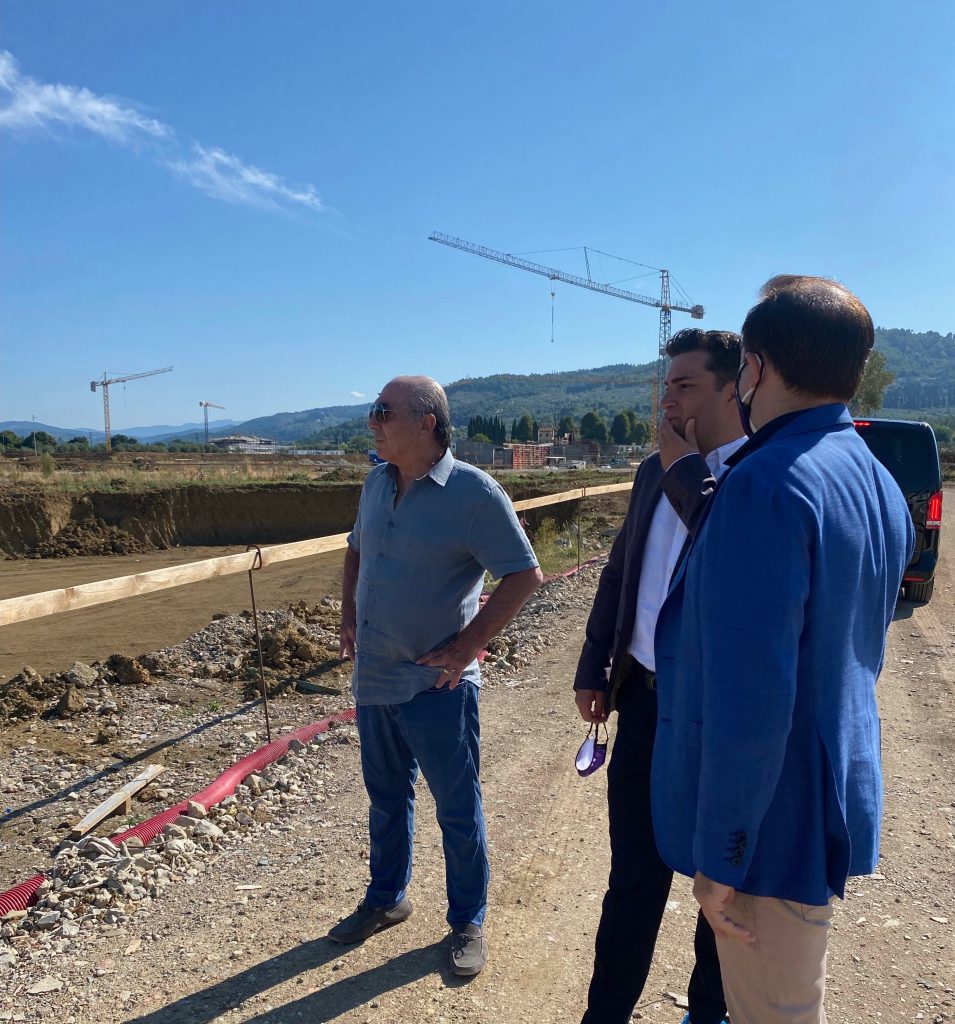
Alessandro overseeing construction of Viola Park in September 2021 with Rocco Commisso and his son Giuseppe.
One of the hardest chapters came in March 2024, when Fiorentina’s general manager, Joe Barone, passed away. “I came here with Rocco directly on a private jet. We did the camera ardente at Viola Park, where 20,000 fans came to pay their respects.” Afterward, Commisso asked him to stay in Florence through the end of the season. Looking back on it all, Alessandro said simply: “It feels like it’s gone by in the blink of an eye. Time flies.”
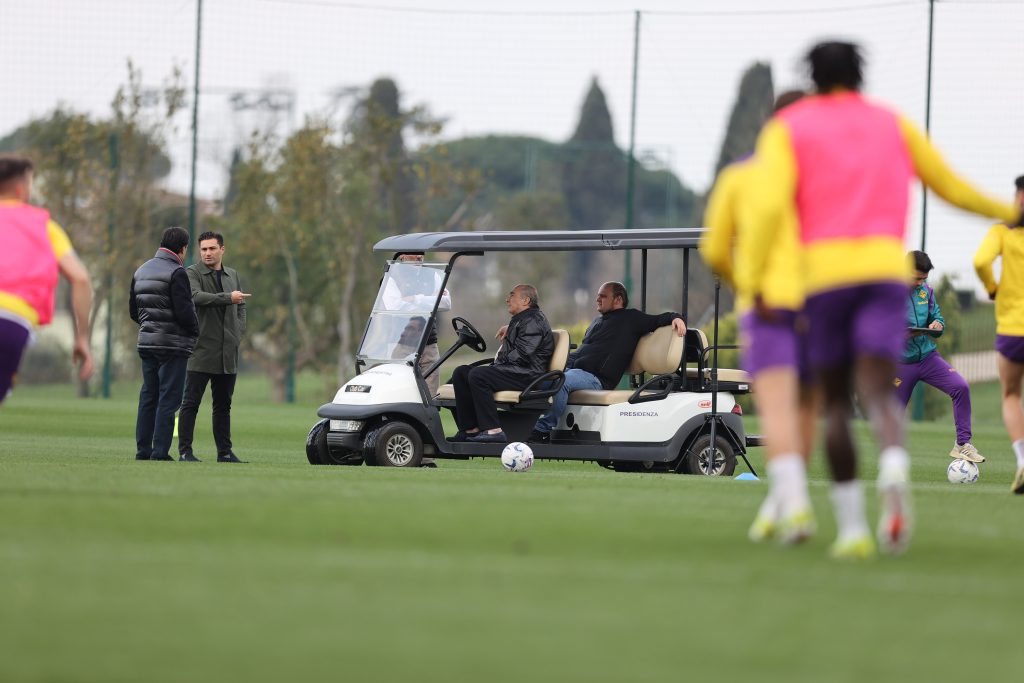
Watching Fiorentina training session at Viola Park alongside Rocco in 2024.
It All Started With a Press Credential
Alessandro says none of it would have happened without his time at Syracuse Florence. “My freshman year, I’d go to games sitting in the Curva Fiesole with the Ultras, or sometimes I’d get a press credential because I was writing for different outlets.” He built his school breaks around matches across Europe — Lisbon, Naples, Paris, Germany.
The turning point came when Fiorentina’s press office gave him that credential as a freshman. “I went there, wrote up a story, and got to interview the players. That was when I first realized maybe this could be a career. If I didn’t come here as a freshman, who knows what would have happened.”
A Second Family in Florence
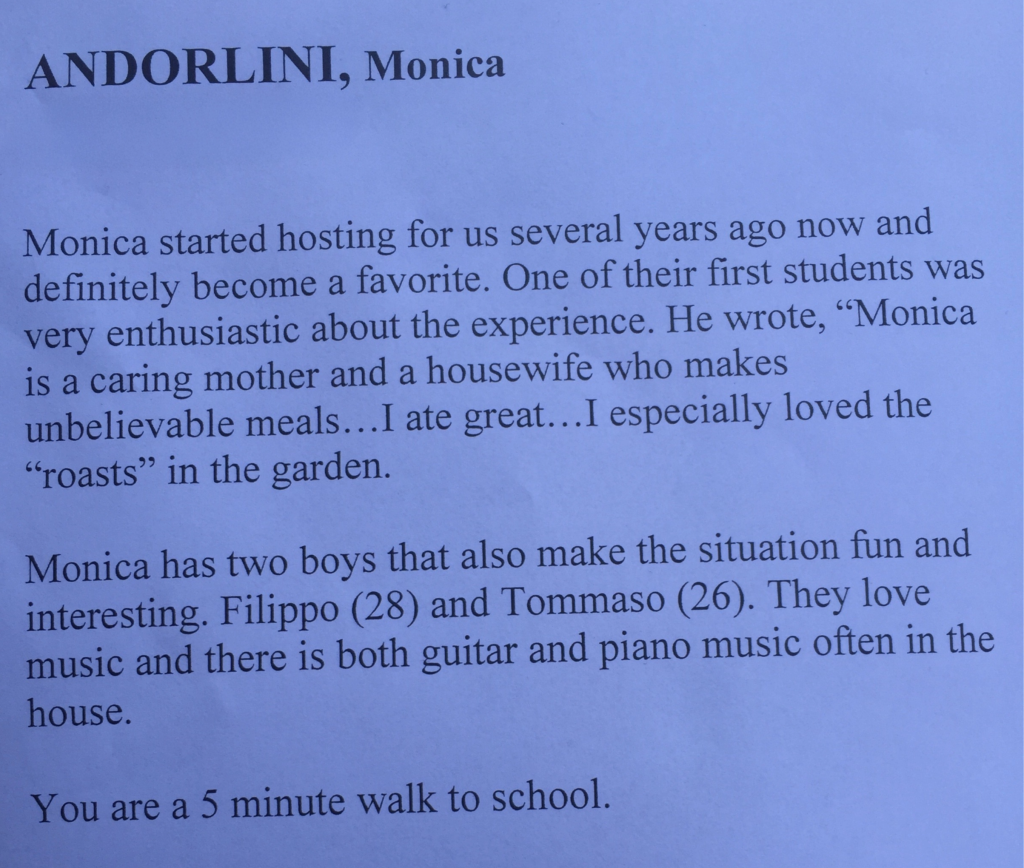
Alessandro lived with the same host family, the Andorlini’s on Via Masaccio, for all three of his semesters — a rarity he credits with changing his life. He still remembers meeting his host parents in Room 13 of the Villa Rossa, and both of his host brothers have since visited him in New York; he attended one brother’s wedding a year and a half ago. He was staying with the family again during this visit.
The information Alessandro received about his host family before they picked him up from the Villa Rossa
His connection to Florence runs deeper still. Two years ago, his parents had coffee here with Professor Debora Spini, whose family his father, historian Stanislao Pugliese, has known for years — Stanislao once interviewed Debora’s brother for one of his books, and gave a lecture at Syracuse Florence during Alessandro’s final semester.
Piazza Savonarola remains his favorite area of the city. “After class, I loved going into the square and seeing all the families with the kids hanging out. My host brothers grew up coming here, we’re just two steps away.” He also spent plenty of time in the Syracuse Florence library — “maybe not so much the first semester, but definitely after.”
Learning Italian — and Falling for Italy All Over Again
Despite his Calabrian roots, Alessandro didn’t grow up speaking Italian. His high school didn’t offer the language, and when his grandparents spoke to his parents in dialect, they responded in English. Then he started Italian 101 as a freshman, with some help from his host family: “They’d say, if you don’t try to speak Italian, we’re not going to feed you. That was good motivation.” He went on to complete a dual major in international relations and Italian studies back at the Syracuse home campus.
His family’s ties to Italy run well beyond Calabria, from cousins who’ve settled near Pesaro to a host brother now working as a judge in Sardinia. “It gives us excuses to go to all the different places to see family,” he said.
As for what’s next: Alessandro’s fiancée, whom he’s been with since high school, studied in Milan the same fall he was back in 2017. The two are now planning to marry in Tuscany. It seems fitting that the place that launched his career will also be where he starts the next chapter of his life.
The Whole Argument for Study Abroad
For Director Sasha Perugini, with whom Alessandro has stayed in touch over the years — “not just with me but with the whole program and especially with his homestay family” — his story is more than a memorable one-off.
“I share his story not because it’s unusual, but because it’s the whole argument for study abroad in one case,” she said. “We talk a great deal about global competencies and cross-cultural fluency, buzz words that flatten what actually happens to people when they leave home for a while and dare to confront uncomfortable scenarios. In the end one learns more about themselves.”
Eleven years after a first-year student told his professor he dreamed of working for Fiorentina, that dream — built, in Perugini’s words, “with more conviction than credentials” — has manifested many times over.
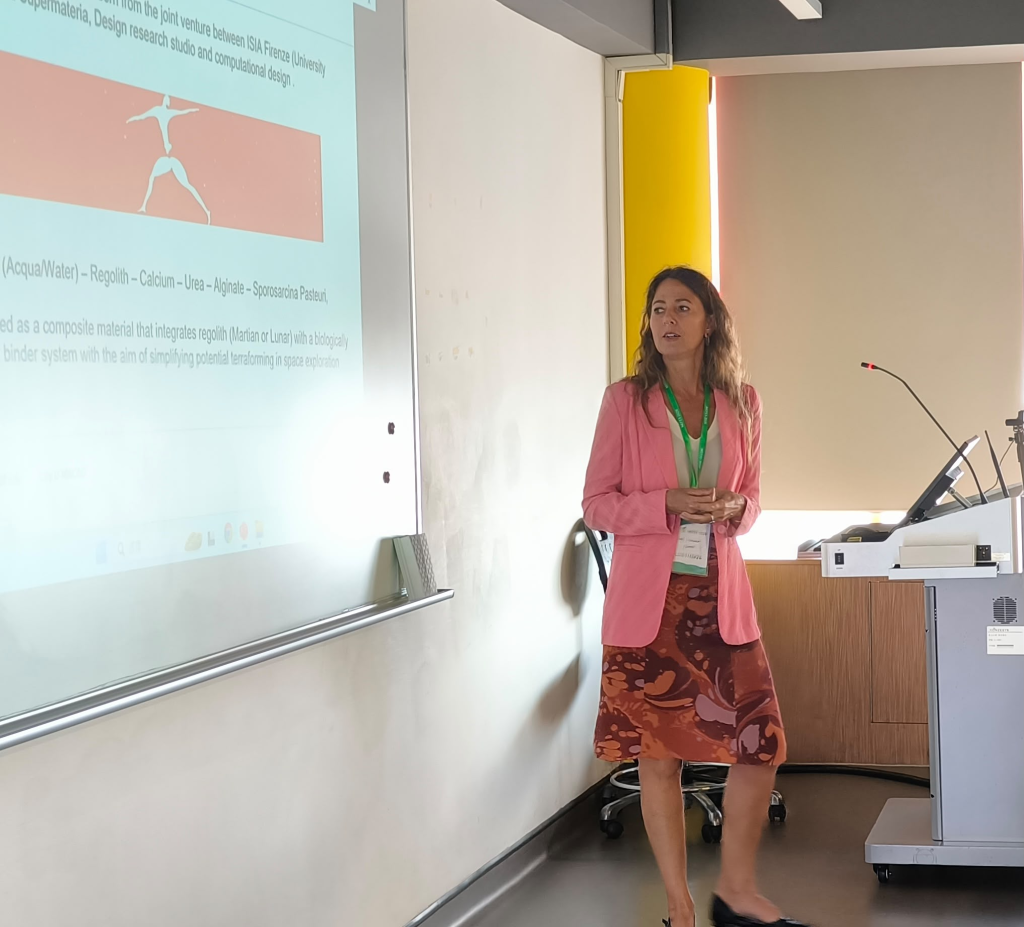
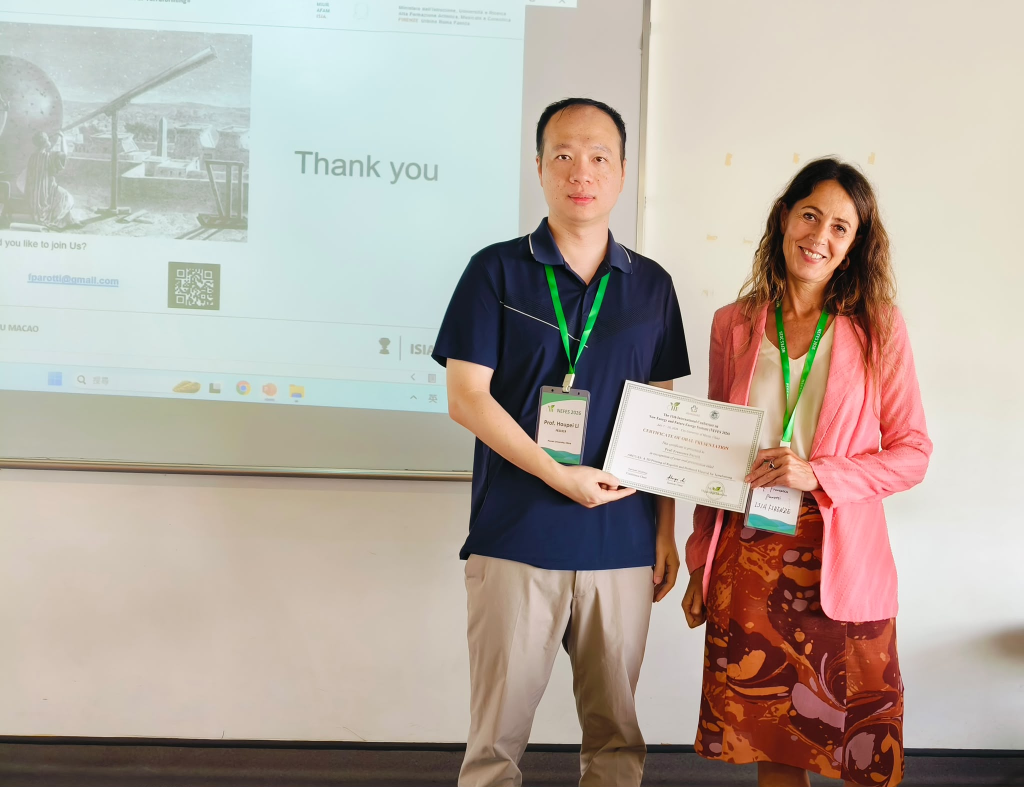
Francesca Parotti presented her paper, “ARCUAS: A 3D Printing of Regolith and Bio-based Material for Terraforming,” at NEFES 2026, the 11th International Conference on New Energy and Future Energy Systems, held July 7–10 in Macao, China. The conference brought together 40 delegates from 16 countries and regions to foster communication across fields connected to new energy and future energy systems.
Parotti’s paper appeared in a session on “Smart Grids, Low Carbon Conversion and Functional Energy Materials,” introducing ARCUAS, a project developed with ISIA Firenze design school and Supermateria, a research studio focused on computational design. The name—Acqua/Water, Regolith, Calcium, Urea, Alginate, Sporosarcina Pasteurii—describes a composite material combining Martian or Lunar regolith with a biologically activated binder, aimed at simplifying terraforming for future space exploration.
Reflecting on the work’s significance, Parotti noted, “The ambition to travel in space and establish a permanent human presence on the moon or on Mars is reshaping how design research approaches materials, fabrication, and infrastructure.” The Syracuse Florence community congratulates Professor Parotti on sharing this research on an international stage.
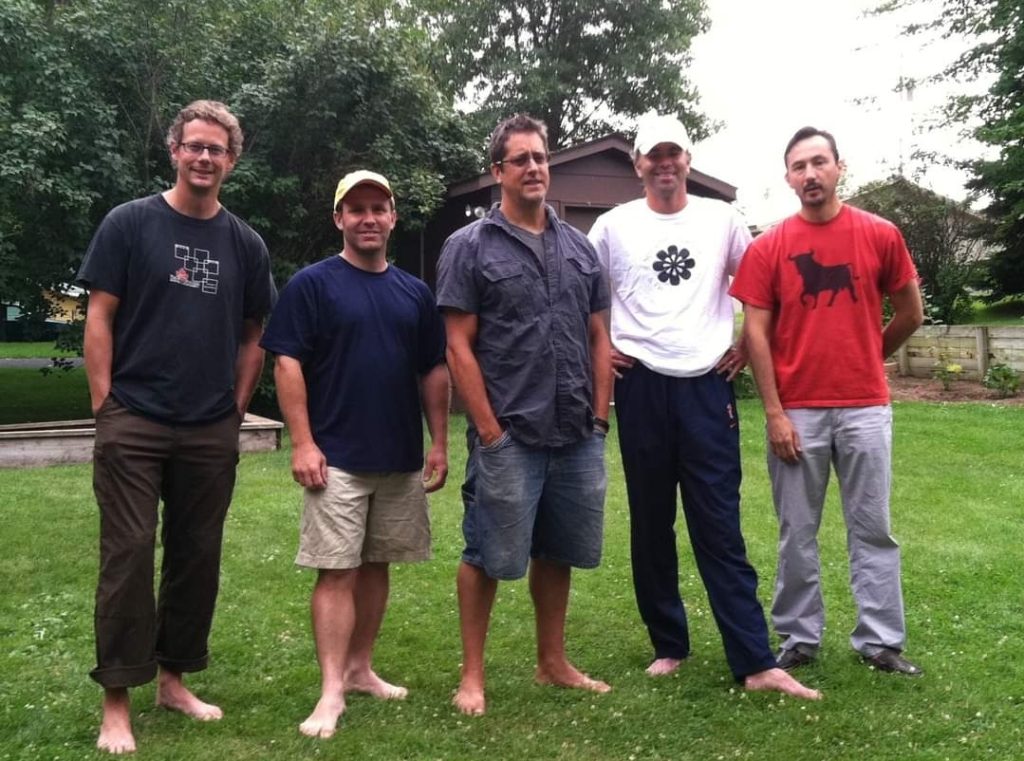
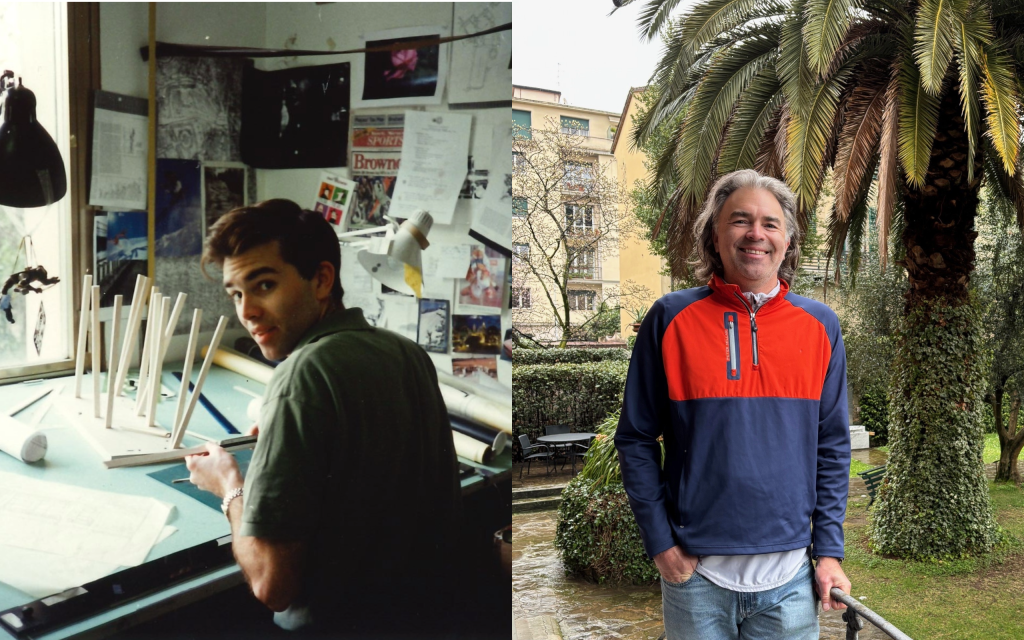
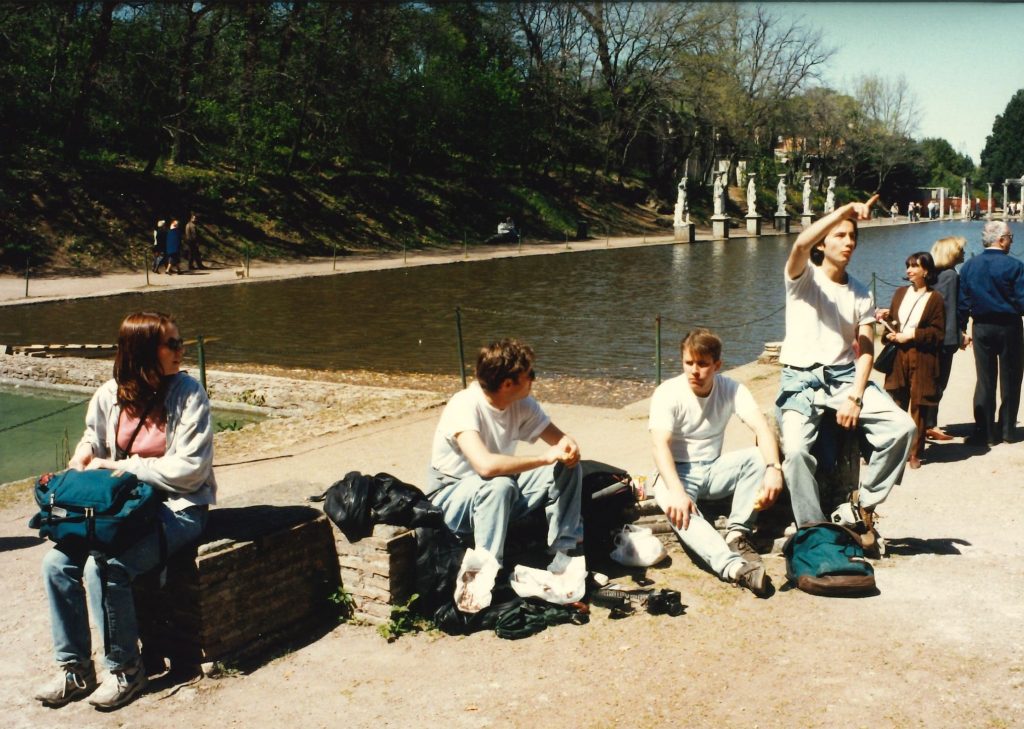
When Bruce Siska, Jason Halter, Matt Lysne, Ed Muehlberg, and Ernesto Teran arrived in Florence for the one-year Master of Architecture program in the fall of 1994, they were five strangers among a class of eleven. By the time they left the following spring, they were something closer to brothers. Thirty years later, that bond hasn’t faded — and when Bruce returned to Villa Rossa last year, it brought a flood of memories that Bruce, Matt, and Ed were happy to share.
Bruce then and now
“I think we can all agree that our year in Florence was pretty epic, life changing, and beyond memorable,” Bruce said.
Field trip to Hadrian’s Villa
An Apartment Lost, and a Friendship Found
The five almost didn’t have a place to live. Within their first days in the city, a young count offered to rent the group an apartment overlooking the Arno. They shook hands and agreed to meet the next morning at Villa Rossa — only to watch, on their way out, four pretty female students from Florida State arrive to tour the same place. Sure enough, the count never showed the next day.
Bruce and Jason spent the next week sleeping on their drafting tables in the M.Arch studio while the search continued. It wasn’t all bad — the two met a slew of memorable people during those homeless days, including a countess who hosted them at her palazzo near Santa Croce. “Toward the end of that week, we had dragged all of our luggage down to Ernesto’s apartment only to find he was out,” Bruce recalled. Defeated, they hauled their bags to Piazza Santa Croce and sat down to watch a group of local boys playing soccer. When one of the younger boys took a ball to the face, his friends picked him up, dusted him off, and sent him right back into the game.
“We had an epiphany at that moment that life wasn’t so bad,” Bruce said. They found an apartment the next day.
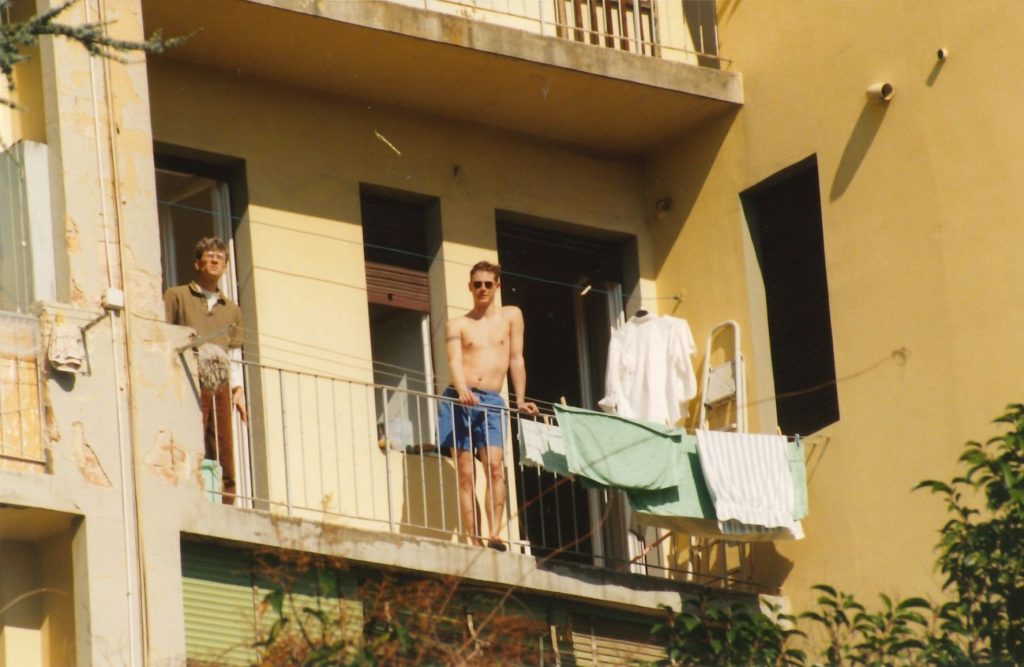
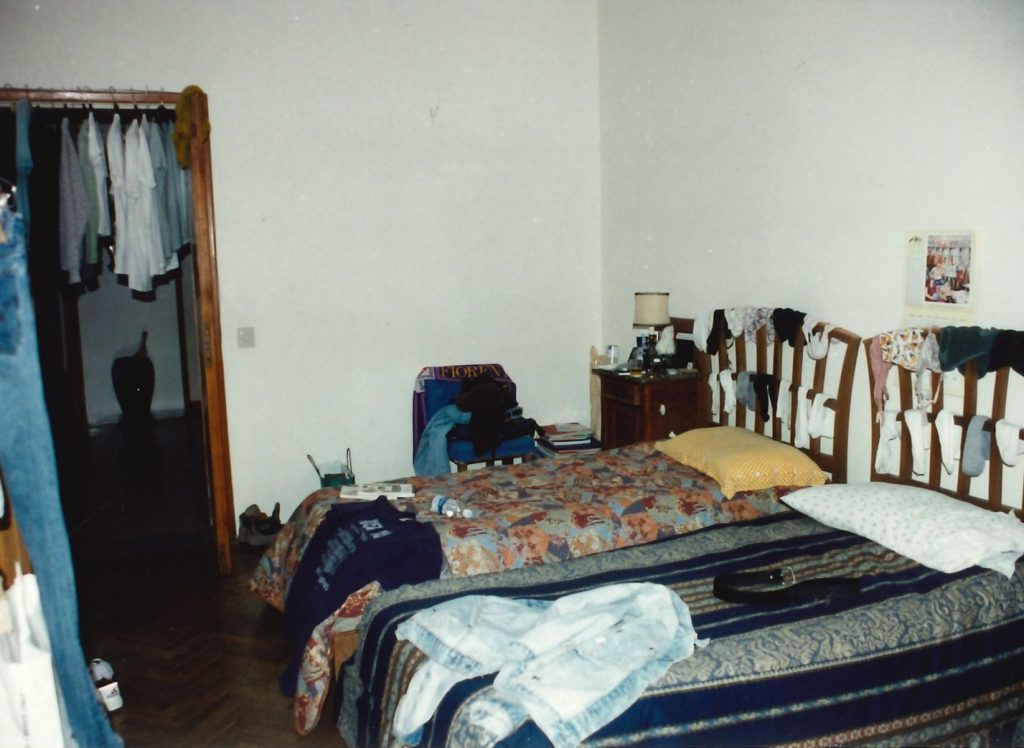
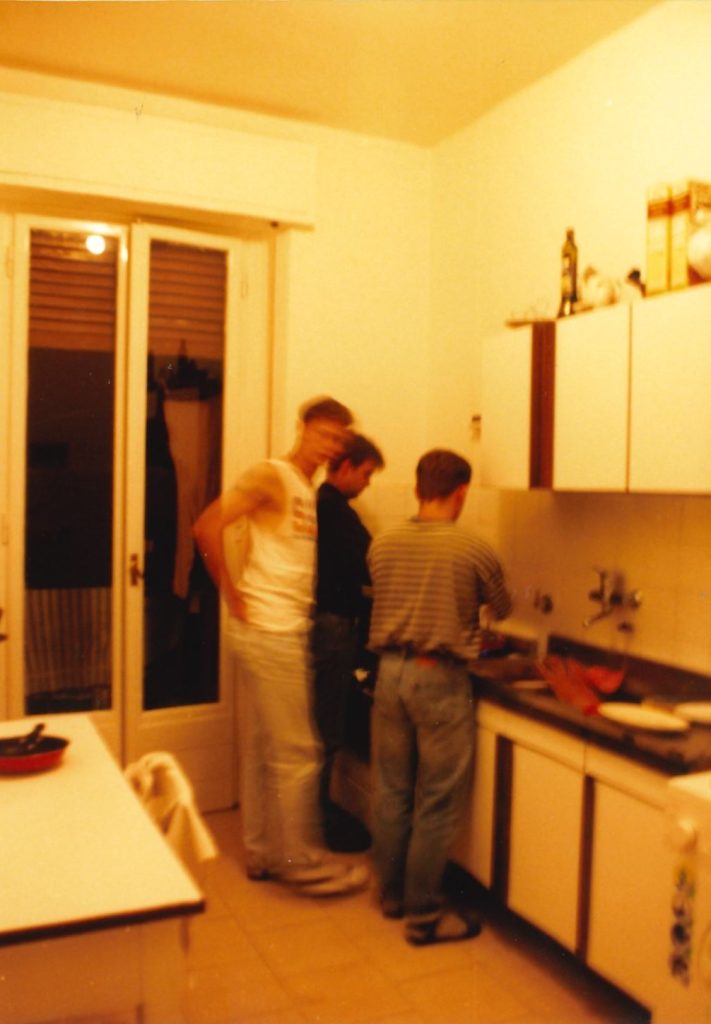
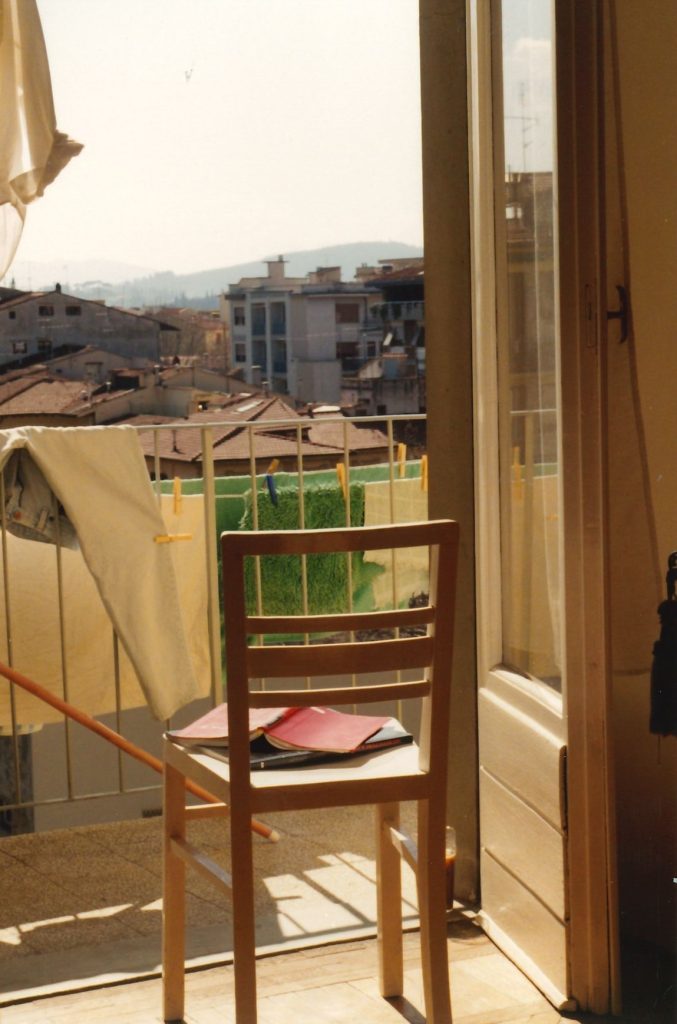
Apartment balconyLaundry dayKitchen time with roommatesMorning view
Lunch, Foosball, and a Year Planned to the Day
Their professor, Steven Peterson — known to the group simply as “Coach” — spent that year in Florence with his wife, architect Barbara Littenberg, and ran the program with a rhythm the group still remembers fondly. “Coach had the year planned out to the day,” Bruce said. “He planned out the projects we would be working on and designing, then we would travel to places that related to each project.”
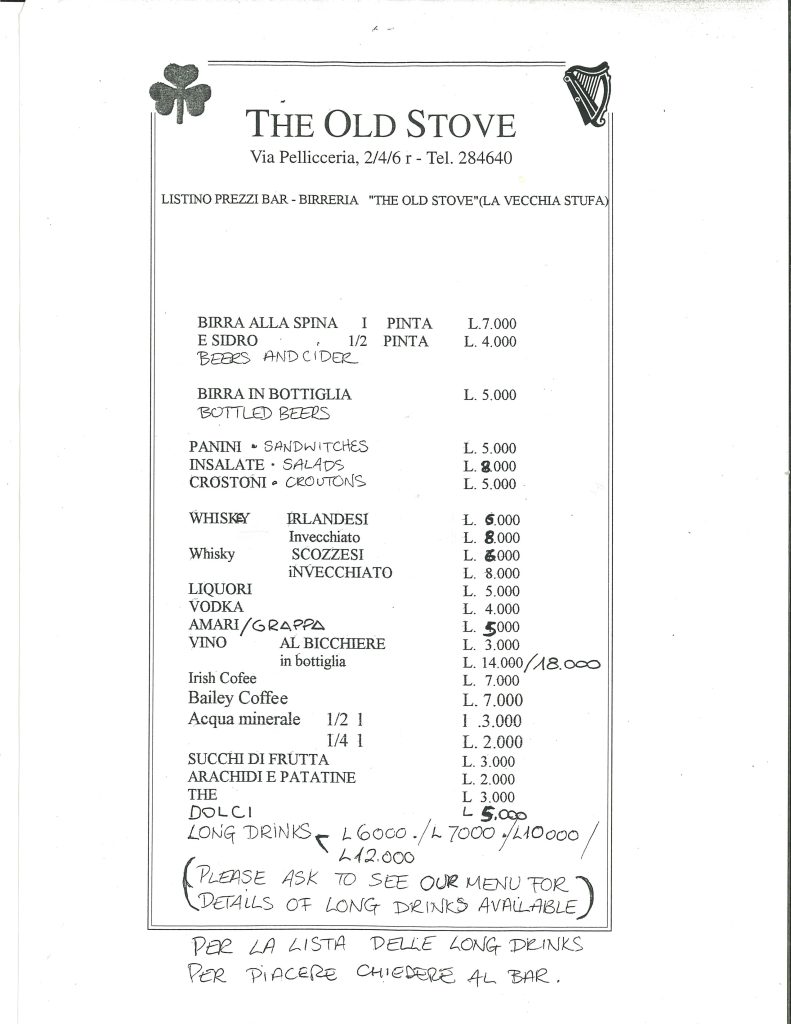
Days fell into a routine: mornings in class, lunch together at Taverna degli Artisti around the corner, foosball at Villa Rossa, studio in the afternoon, and — depending on discipline — a pint or two at the Old Stove Pub before heading home, followed by a return to studio to “work” late into the night, a term Bruce admits was often used loosely.
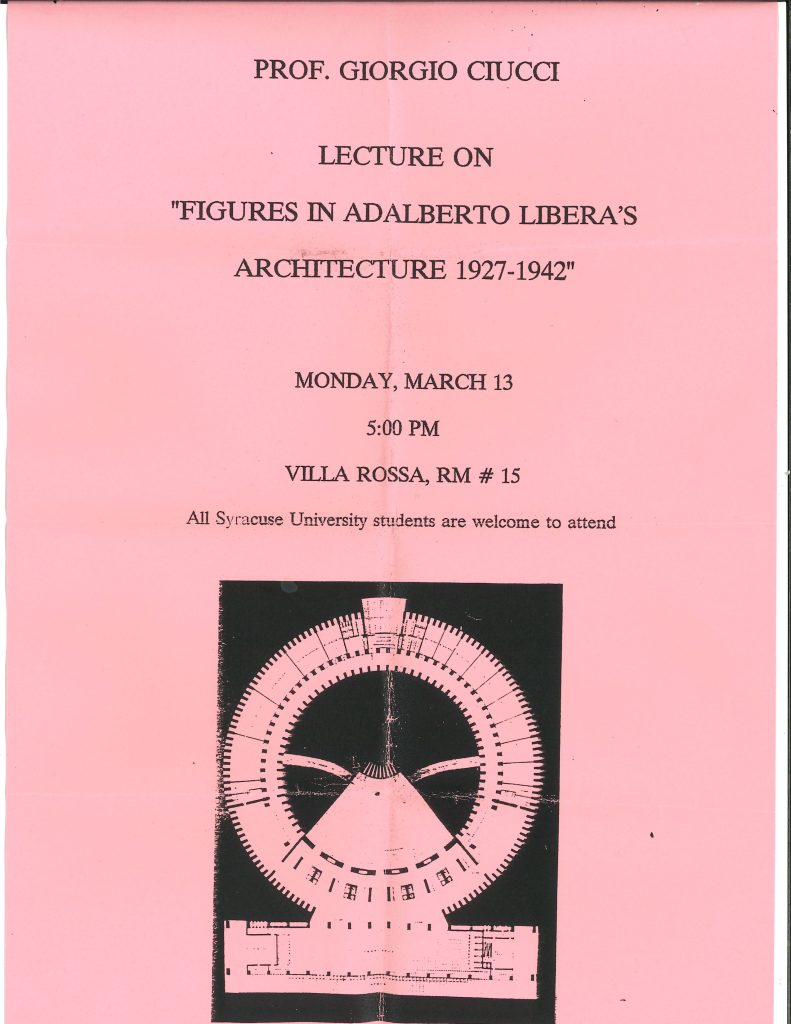
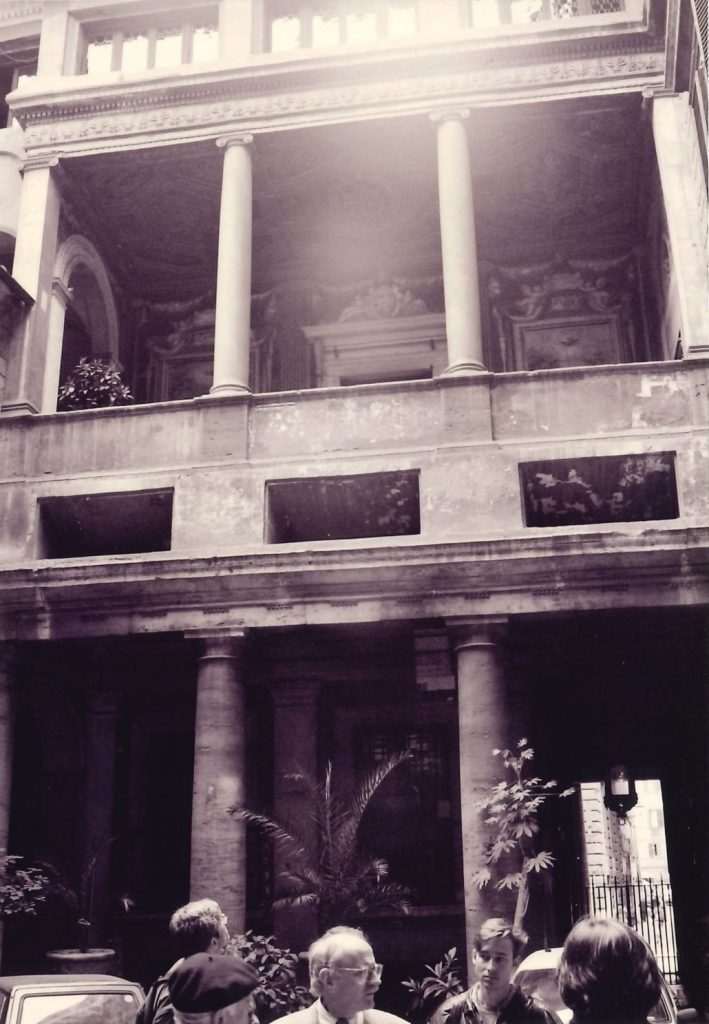
The classes themselves left an impression, too: Giorgio Ciucci’s course was, in Bruce’s words, unreal, and Marcello Fantoni taught a class devoted entirely to the Medici dynasty. Ciucci later invited the group to his home in Rome for aperitivi and snacks — the kind of hospitality, Matt said, that “is real” in Italy in a way that’s hard to describe to people who haven’t experienced it.
Professor Giorgio Ciucci bottom centerEd
When Ed was asked, in a job interview shortly after returning to the U.S., what his favorite part of studying abroad had been, one word came out before he could stop it: “Lunch.”
“I quickly had to elaborate that part of our daily routine was stopping what we were doing and meeting up at Taverna degli Artisti,” Ed said. “It was this routine and focus — enjoying good food and company — that I liked the most about my time in Florence.” He got the job, for what it’s worth.
Jason
Lost in Translation
Cross-cultural mishaps were a constant, and the group still keeps a running list of favorites. There was the class with Giorgio Ciucci, in which the students spent several confused minutes trying to understand why he kept insisting “the cows are in the woods” — before realizing he meant chaos, not cattle. There was Matt’s trip to pick up his girlfriend (now wife) in Milan, where he asked Architecture Assistant Carla Fioravanti for a hotel recommendation. She booked him a room at the Hotel Monopoli, and he walked past the sign twice, unable to reconcile her pronunciation (“moh noh polly”) with the board game stamped into his American brain.
Class dinnerMatt in the studio
Ed learned Italian the hard way, one word at a time. “We had to quickly learn some key Italian words — like sciopero (strike) — to understand why the bus suddenly stopped mid-route, why the grocery stores were randomly closed, why the trains stopped running, and so on,” he said. He also discovered, more slowly than he’d like to admit, that Florentines judge newcomers by their shoes. Once he traded his hiking boots for proper Italian leather, he noticed people on the street actually looking up and saying ciao.
Then there was the train strike that stranded the whole group in Venice, forcing Coach to scramble for last-minute lodging and tickets home — just one more afternoon that became a story they’d tell for decades.
Class in the fieldErnesto in Venice
Learning to Live at a Different Speed
For a group of Americans used to checking things off a list, Florence had a way of humbling even the most organized among them. Ed, a committed list-maker, quickly learned that trying to run more than one errand a day was asking for trouble. Between random strikes, unannounced religious holidays, and shops that simply closed when they felt like it, efficiency wasn’t really on the table. “If a store was closed, that just meant you now had time to grab an espresso and sit in the piazza for a while and watch the kids play soccer against some historic church,” he said.
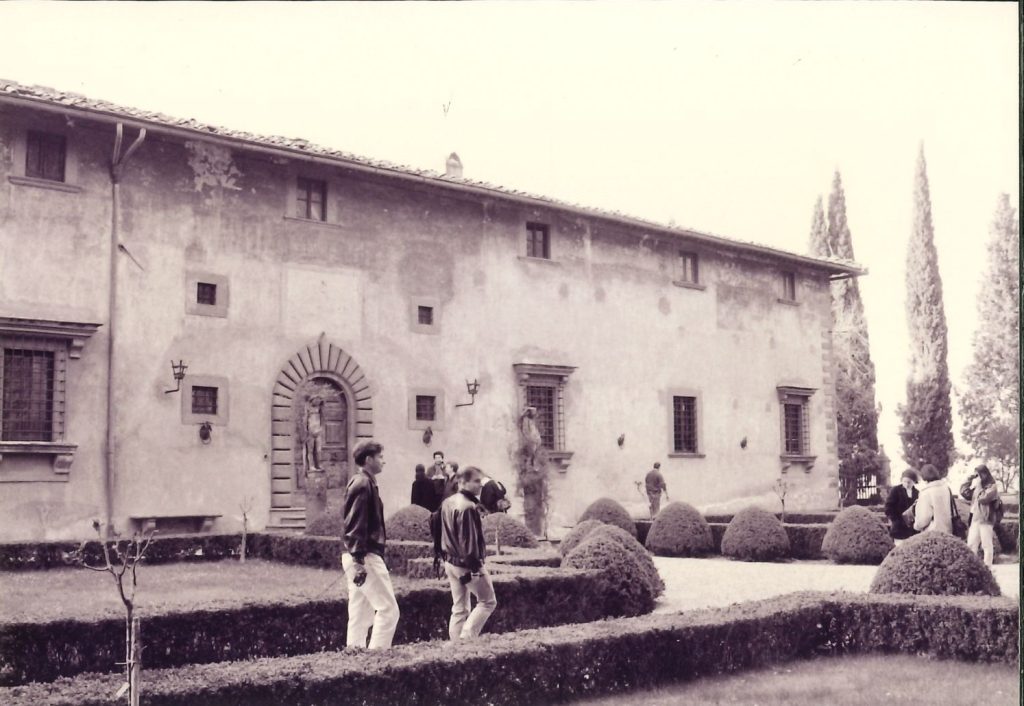
Last villa garden tour
Money brought out a competitive streak. Back when travelers’ checks were still a thing, exchange rates and fees seemed to vary wildly from teller to teller, with no obvious logic. Ed and Matt once tested this directly — walking into the same bank, at the same time, to cash in the same amount of checks — and walked out with different rates. Matt came out ahead. Ed, by his own admission, is still a little bitter about it.
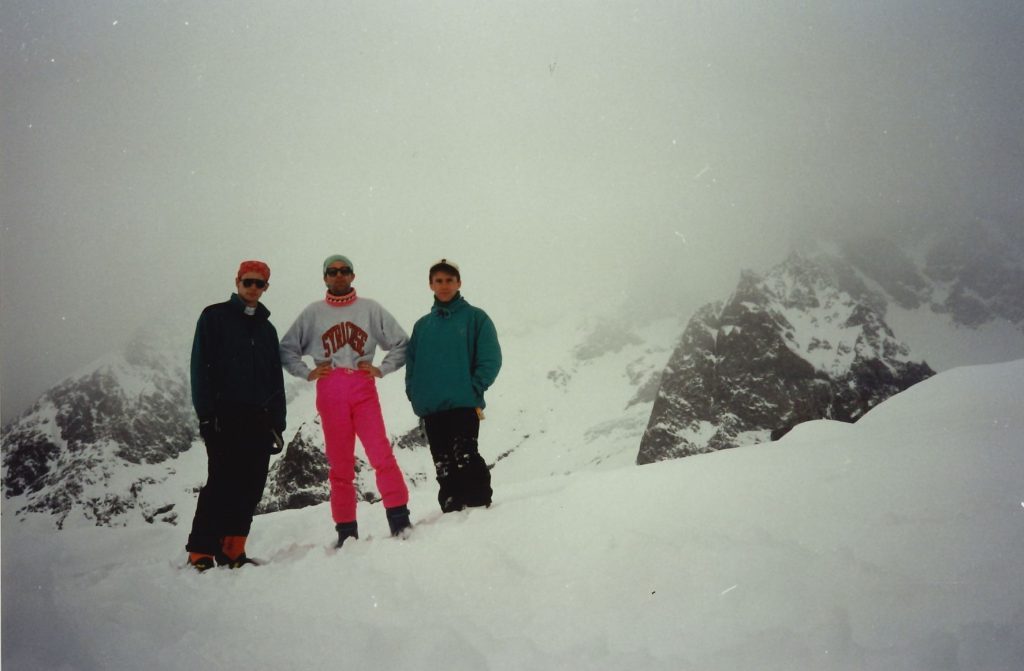
Spring break in the Alps
Mail was its own adventure. One spring afternoon, Matt got a call from a friend back home who had just landed in Florence, wanting directions to the apartment. Matt figured he’d been given a heads-up and hadn’t caught it — until dinner, when his friend mentioned the letter he’d sent explaining the visit. That letter, postmarked in Minneapolis in early January, arrived three days after his friend had already come and gone.
What Stayed With Them
All three credit the year with shaping not just their careers, but how they’ve approached life since. Bruce went on to open his own architecture practice. Matt has led study-abroad trips of his own, drawing directly on his Syracuse experience, and still finds himself solving problems today with ideas from studio projects that once annoyed him. Ed says the year taught him to slow down, ask questions, and stay level-headed under pressure — lessons that have mattered more in his personal life than his professional one.
Barbara, Bruce, and JasonWalking tour
Both Bruce and Matt have been back to Florence since — Bruce twice, once with his own two sons in tow. “Thankfully the city has not changed, aesthetically,” Bruce said. “There is a more relaxed feeling when you know you will be living in the city for a good amount of time… to slow down daily life and appreciate that was one of the things I will always remember.” Matt made a similar pilgrimage in 2016, walking his own family past his old apartment building, the old studio space (now, fittingly, a bar), and back around Villa Rossa.
Three decades on, the group’s five has multiplied. Each of them married and started a family, and by Matt’s count the five friends have turned into twenty between them — give or take, since Bruce “blew it” by having two sons instead of the two-and-two split that would have made the math even neater.
Their advice for today’s students is nearly unanimous: use your Italian, however bad it is. Keep a journal or sketchbook and write down everything, every day — the people, the places, the small stuff — because in a few years, you’ll be glad you did. Don’t rush your days off; you’ll know you’ve truly settled in once you can spend one without an agenda. And, as Ed put it, when something goes wrong, “take a step back and look around, and remember where you are and what you are actually doing. That solves most problems.”
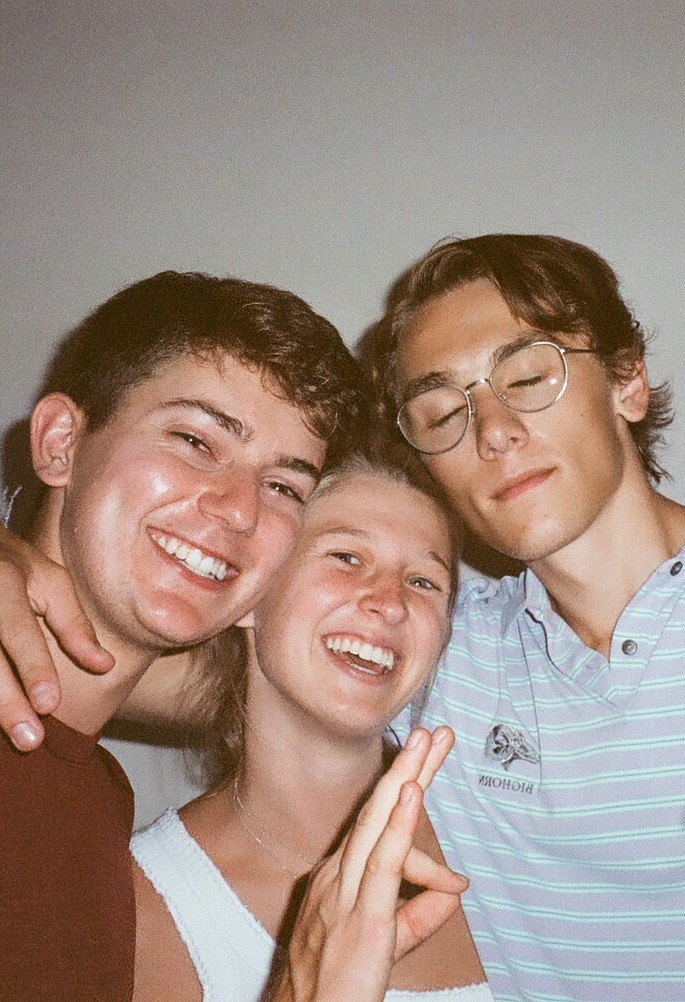
Will (far left) and Griffin (far right), with friends Austin Dickieson and Dan Janzow
Griffin and Will met by accident — a last-minute plane seat, a roommate’s invitation, an apartment near Villa Rossa with room for one more — and turned it into something that’s lasted years past the semester that started it. What began over shared taste in music and art became weekend trips across Italy, late nights making art together, and a standing Tuesday ritual in Piazza Savonarola that turned into a tradition six friends still hold onto, now bittersweet since losing their friend Isaac. Griffin found a second family in his host parents, Manlio and Vera; Will found the confidence that comes from leaning into the unfamiliar. Back home in New York City, they shared their memories of the semester that changed them.
You met on the Syracuse Florence program. Please tell us about that.
Griffin: It was very serendipitous! On the initial flight to Florence, I was sitting in the middle aisle with my friend and roommate Nick DeSantis when someone rushed on the plane last minute and sat directly next to him. He and Nick started instantly bantering, and that banter led to us meeting our first friend in Florence: Austin Dickieson. Early in the semester Austin hosted some people at his apartment where he was living with five other art students, and Will was one of his roommates. That night Will and I immediately connected over similar music taste, a shared love of making art, and a general instinct that we were meant to become friends.
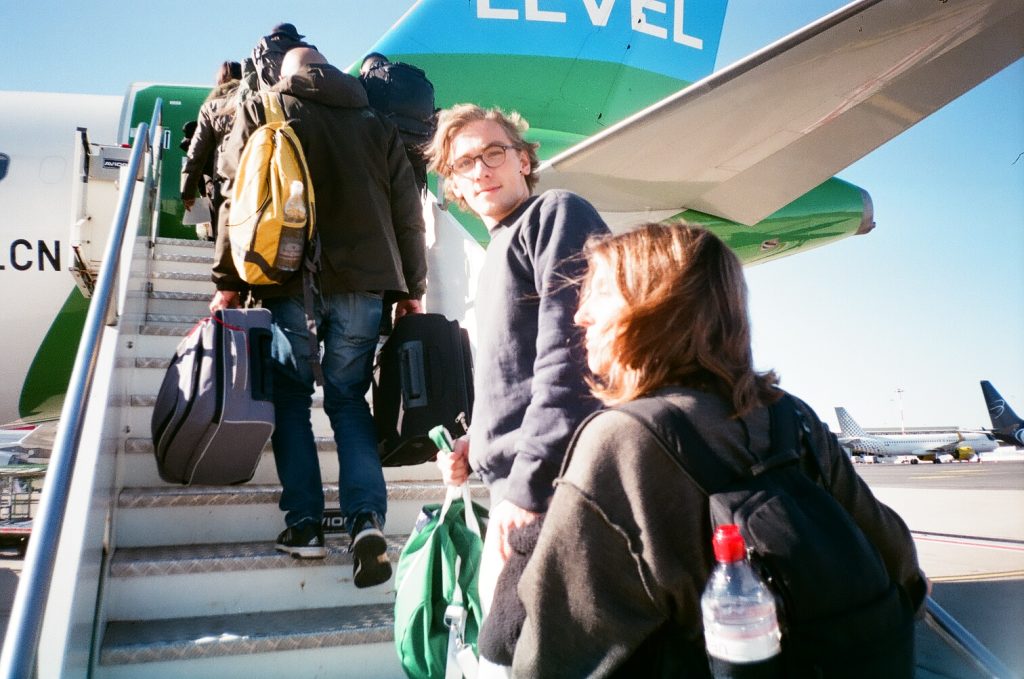
Will boarding a plane with Jane Ackles
Soon after that, we began travelling together on weekends, and his entire apartment became my closest friends in Florence. Each night after I finished eating dinner and chatting with my host family, I’d rush over to Will’s apartment to hang out with everyone. We all bonded with each other very quickly, and spent many nights making collaborative drawings, exploring Florence and enjoying each other’s company. After our senior year of college, my friend Dan Janzow and I went to Santa Clara University to visit Will and our other friends from abroad and celebrate their graduation with them.
Griffin (second from the left) and Will (third from right) with Jane, Isaac Scharbach, Austin, Dan, and Remy Farrell
Since then, we’ve remained close and now both live in New York City, where I’m from! Will has met many of my friends from home and has really ingratiated himself into the community I’ve built here, which has been amazing.
Will: I knew several Santa Clara students who I was going to be living with in an apartment in Florence. What an incredible experience! When we first arrived, my roommate Austin had let me know immediately of a few students he met on his flight over to Italy that he befriended, and how I needed to meet them. During the first week we invited some students over to our apartment including Griffin, and he and I immediately hit it off. Griffin and I were constantly together. He and I in particular were always exploring the city, creating art, and documenting and photographing our experiences.
Do you have any funny/touching stories about adjusting to living in Italy?
Griffin: One of the first days in Florence I went to [the grocery store] Esselunga with some of the friends I’ve mentioned above, and we noticed that they sold packs of exactly two beers. For some reason, that quantity of beer was very amusing to us as we hadn’t ever seen it packaged that way in the U.S. At that moment we came up with the idea of Two Pack Tuesday where we would meet every Tuesday night in Piazza Savonarola, and each consume exactly two beers. It ended up being a really memorable ritual, and each week we would invite different people from SU Florence to join us. We still talk about it today and hope to gather everyone together again one day for another Two Pack outside of Villa Rossa. Tragically, our close friend Isaac Scharbach passed away soon after the semester ended, and this future Two Pack meeting will definitely be dedicated to him.
Will: Two Pack Tuesday! What a silly little tradition that has grown to mean so much! We were so amused by the two-packs at Esselunga that the six of us decided to make it a weekly ritual to gather in the park and discuss the happenings of the week over a pair of beverages and great company. And we’re still in touch! All of us remain great friends to this day, and I see Nick and Griffin almost weekly since we all live in NYC. I even also lived with Dan in Massachusetts for a year after college!
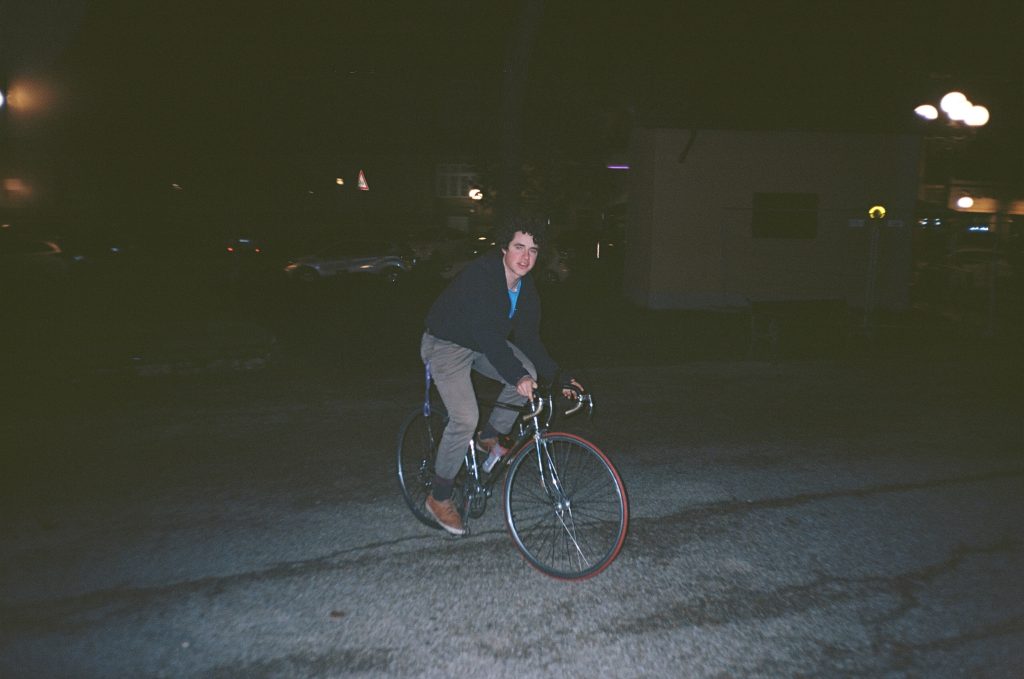
Isaac and his bikeAustin in Piazza Savonarola
It was so tragic to hear about the passing of our friend Isaac right after the program, and it will be such a special moment when we can all gather in Piazza Savonarola and honor him. Special shoutout to Nick, Griffin, Dan, Austin, and Isaac, who I was lucky enough to share a few “Two-Packs” with. I also had an incredible experience playing soccer through the Syracuse program against other programs in the area. The competition was ripe! And it was fun to gather with everyone in the evenings for some good games. So many memories!
What were your host family situations like?
Griffin: My roommate Nick and I lived with an older couple named Manlio and Vera in a beautiful apartment near Santa Croce. My dad has a friend whose daughter lived with them a few years before during her semester abroad and she recommended that we request them as host parents. I’m beyond grateful that ended up happening, because my experience wouldn’t have been nearly the same without them. They are some of the most lovely and caring people I’ve ever met, and we were all immediately endeared to each other. Apparently, before us they hadn’t hosted male students before and were very surprised when we requested them.
Nick DeSantis on the first day at their homestay
During those four months they really made Nick and I feel as if we had always been members of their family. We developed a shared language to communicate with each other that consisted of our basic Italian, their basic English, and Nick’s absurd hybrid of body movements/dance/exaggerated facial expressions. Each night they cooked us some of the best meals of our lives and lovingly shooed us away to go have fun when we tried to help clean up. We all hugged and cried the very last moment we said goodbye before leaving for the airport to head back home.
Vera, Nick, Manlio, and Griffin in 2019Griffin with Manlio and Vera in 2025
Will and I returned to Florence last June to visit for the first time since 2019 and had dinner with Manlio and Vera in their apartment. Reuniting with them was really emotional, and was one of the most wholesome, meaningful nights of my life thus far.
Will: I lived with four SCU students and one UVM art student in a lovely little apartment right near Villa Rossa. We made it a ritual to grocery shop at Esselunga almost every day and quickly got into a rhythm of cooking, commuting to class, etc. I even found a gym that I joined with Austin!
Will (right) with Austin and Haley SkinnerFrom left: Austin, Sarah Neil, Brooke Wanzenberg, Jane, Haley, and RemyWill and Brooke
How did your study abroad experience influence your life afterward?
Griffin: I really feel that my semester abroad changed everything for me. Since returning to the U.S. in 2019, I’ve developed a strong passion for travel, and I’m more interested in exploring other countries’ cultures than I ever was before. Having grown up as a picky eater as well, living with a host family broadened my culinary horizons and changed my dietary patterns for the better. I think about my experience in Florence daily, and it’s remained a very important city to me all these years later. In the future I hope to return to Europe for at least a year, as I know I wouldn’t be content with myself if I didn’t attempt to have another similar experience to my time in Florence. I’m even solo travelling to Warsaw and Krakow for the first time in two weeks, something I definitely wouldn’t have had the confidence to do without my semester abroad.
Griffin (second from right) with Isaac, Austin, Dan, Jane, and BrookeWill at the Colosseum with Sarah
Will: My experience abroad was maybe the best 4-month stretch of my whole life. And I don’t say that lightly. I did an incredible amount of living and traveling in such a short period of time. And to be completely immersed in another country and culture is something that challenged me and inspired me to get out of my shell in so many ways.
Advice for current students?
Griffin: My main advice is to make the most of every single moment. Before you know it the semester will be done and you’ll be wishing you were back in Florence! Spend as much time as you physically can just walking around and exploring the city, and as little time as possible in your room on your phone or laptop — there will be time for that when you get back home! During my semester, I wish I had made more of an effort to explore the outskirts of Florence as well, and venture to parts of the city that are less visited by students. Be adventurous and outgoing! Spend time befriending fellow abroad students, locals, and most importantly, your host family.
Will: In life, you are given the opportunity to lean into challenges and discomfort, and I implore any students studying abroad to do exactly that. I wasn’t so sure about where I would go, who I would meet, or really how any of the experience was going to go, but I’m so happy to have tried all of the things I did. When Griffin and I had the opportunity to return to Florence last year, we made an effort to go to all of our favorite places, but we also found so many new ones by just walking around! The world is so big, get out there and look around!
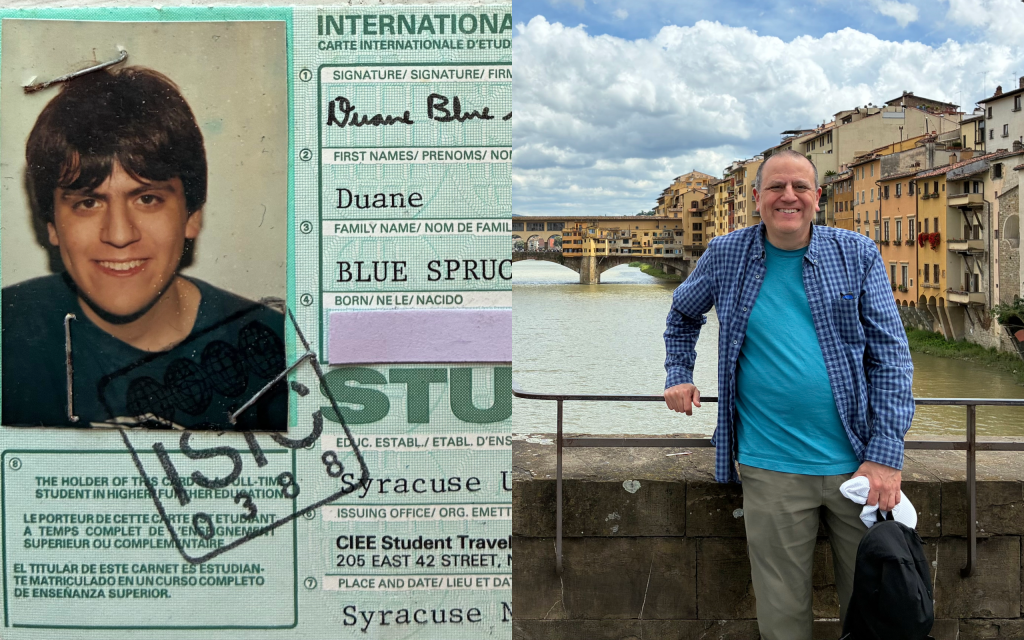
“My International Student Identity Card was very important. I used it to get discounted lunches at the University of Florence mensa.”
In Fall 1982, Duane Blue Spruce left Slocum Hall for a semester with Syracuse Florence as a fourth-year architecture student, living with a nonna on Via del Pallone and forging an unlikely friendship with an Italian teenager that led to a Thanksgiving dinner and a World Cup-era soccer match. Over 40 years later, he returned to Villa Rossa to see how the program and the city have changed, journal in hand from the only time in his life he’s kept one.
It’s rare for our architecture students to live with host families, but you did. What was that like?
My SU roommate, Don Argus (Architecture), and I shared a bedroom in the apartment of a nonna – Signora Luisa Colzi. She lived about a 15-minute walk from Piazza Savonarola. As architecture students, we didn’t spend much time there except to sleep and eat breakfast. I remember that hot water was at a premium, so we were each limited to 1-2 showers per week. We supplemented this by showering on our weekend field trips outside of Florence!
Do you have any funny/interesting/moving stories about adapting to the Italian culture?
This was my first trip abroad. Even as a jaded New Yorker, I was immediately enchanted with Italy’s historic beauty and with the warmth and hospitality of the Italian people. Italy had just won the World Cup so maybe the whole country was in a good mood! My positive encounters with Italians were a strong incentive for me to learn the language as quickly as possible.
After about a month, I was lucky enough to befriend an Italian teenager named Max. He approached me on the street because he wanted to practice his English and talk about the NBA! He played basketball and was over 6’ tall. Max invited me to dinner with his family, and I also attended one of his basketball games. I invited him and his sister, Alessandra, to the SU Thanksgiving party at Piazza Savonarola where they tried things like stuffing and pumpkin pie for the first time. Later, he took me and a couple of other students to a soccer game between Florence and Torino. The match ended in a scoreless tie, but the stadium atmosphere was fantastic, and we got to see two Florentine players, Antognoni and Graziani, from the World Cup team. It was a day when we really felt like locals.
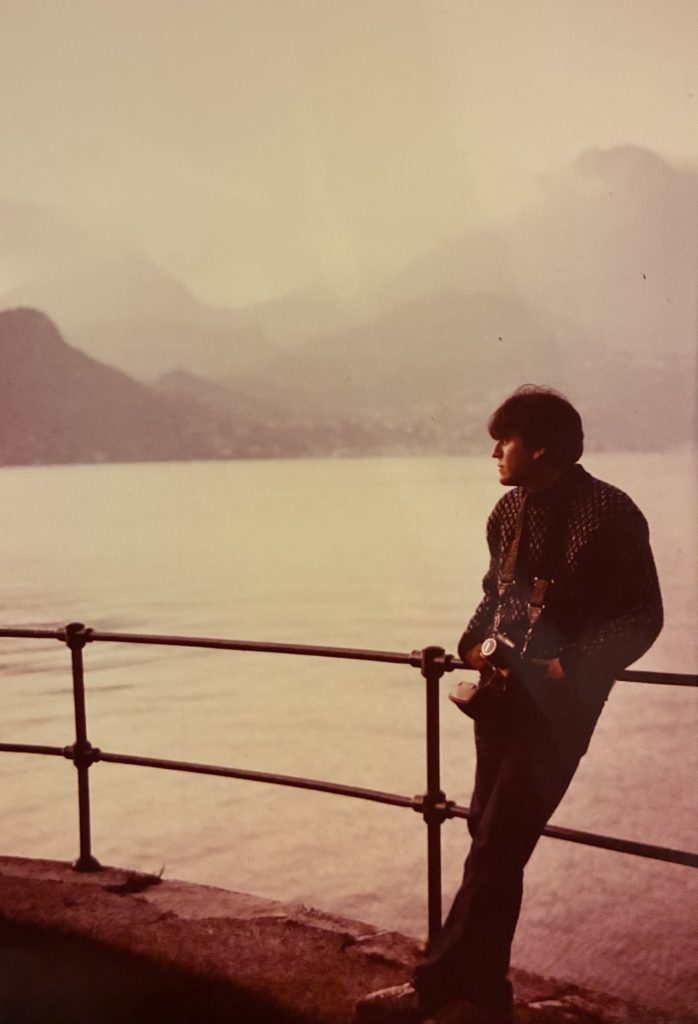
Duane at Lake Como in 1982
What did you like most about the Syracuse Florence program?
Aside from the gelato and living in one of the most beautiful cities in the world, I most enjoyed being able to experience firsthand some of the world’s greatest works of art and architecture. The whole experience was a welcome departure from the isolation and rigors of Slocum Hall and only being able to study these buildings in books or slides. Our curated weekend field trips took us to numerous places outside of Florence that we probably never would have visited on our own. Architecture is best experienced in person and the Florence program gave me that opportunity for 4 months.
How did your study abroad experience affect your life afterwards?
My experience boosted my confidence and my openness to different experiences. My SU campus experience was perhaps a little sheltered. By having to fend for myself in a foreign country at the age of 21, I experienced genuine personal growth.
How does Villa Rossa and Florence compare now to when you were here in 1982?
I kept a journal during my semester in Florence. It is the only time in my life that I have kept a journal. When reading my journal, what stands out is how wonderfully tech-free our lives were! Living phone-free and pre-internet in Florence allowed for a lot of spontaneity, chance encounters, and the freedom to be fully present in the city. Florence today is as beautiful as ever. Of course, there are more tourists now but areas of respite, such as Piazza D’Azeglio, are still as accessible as they were in 1982. Trattoria La Casalinga was a favorite spot in 1982 because it was good and it was cheap. I was glad to see it was still there after 44 years. Still delicious.
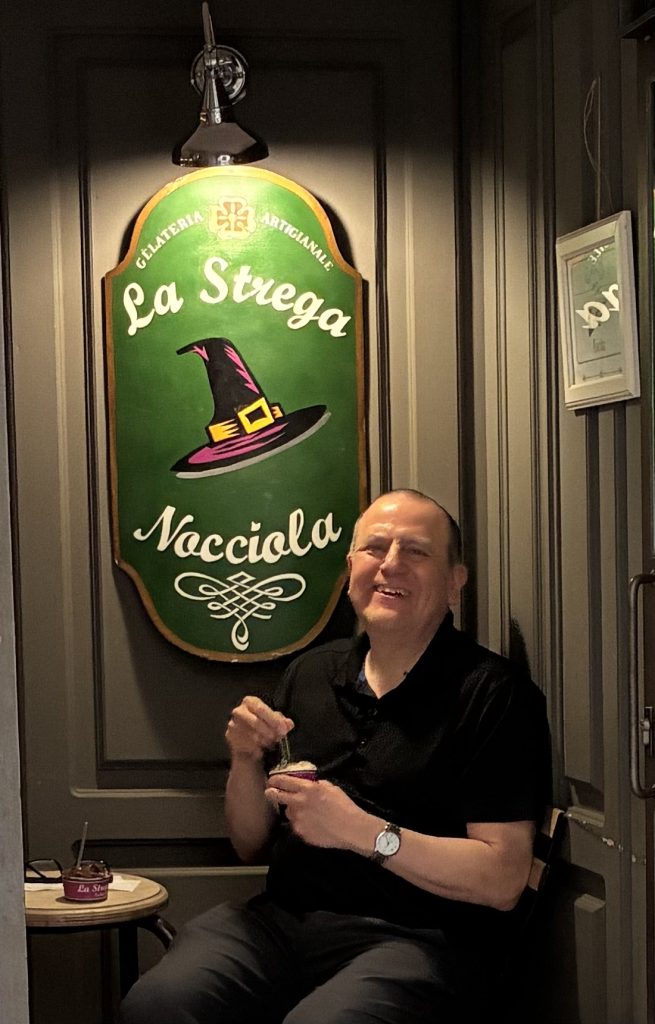
In 1982, gelato was a complete revelation to us. It wasn’t readily available in the US yet and it absolutely blew our minds. Frankly, it still does! A very high percentage of my 1982 journal entries ended with “had some gelato and headed home.”
In 1982, SU occupied the main floor and the garden of Piazza Savonarola. My architecture studio was in Piazza Donatello. On my recent visit, the staff were very welcoming and let me wander around the facilities. I was most impressed with the upstairs classrooms and the separate library building. The students are very lucky to have these physical resources. Special thanks to Valentina Brocchi for her hospitality in showing me around.
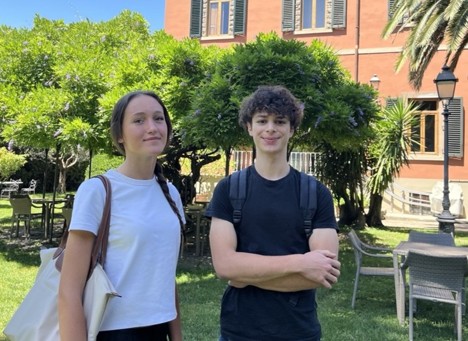
We recently welcomed Greta and Ettore, two students from Duca d’Aosta Salvemini high school in Florence, for a three-week internship with the Academic Department. The experience formed part of the hands-on learning component of their curriculum and allowed them to explore the daily life of an international academic institution from within.
For Greta and Ettore, the internship was first and foremost an experience of discovery.
During their time at Syracuse Florence, they were introduced to the world of study abroad and gained a closer understanding of how an international academic program operates. They observed the many roles, responsibilities, and forms of collaboration that support students, faculty, and staff behind the scenes. Day by day, they became familiar with the rhythm of a professional office environment, where punctuality, communication, attention to detail, and respect for shared spaces all contribute to the smooth functioning of the community.
For students at this stage of their educational journey, an experience like this offers much more than practical training. It can become a first meaningful encounter with the culture of work: learning how to be part of a team, how to adapt to a professional setting, and how to contribute with responsibility and care to a shared goal.
Their internship also encouraged them to look at Florence from a new perspective. Through their work with the Academic Department, Greta and Ettore explored local volunteer associations, community engagement opportunities, and organizations active throughout Florence. In doing so, they encountered a city that extends beyond its familiar image as an international tourist destination. This perspective is central to the mission of Syracuse Florence. As a study abroad center, the University encourages students to move beyond the classroom and engage meaningfully with the city around them. Through field studies, internships, and community engagement, students are invited to take part in the life of Florence and to build relationships that deepen their understanding of the place in which they study.
As part of their internship, Greta and Ettore also contributed to the Villa Rossa Archive, a project of special significance to Syracuse Florence. They supported research related to the Gigliucci family, whose history is closely connected to Villa Rossa, the main building of the Syracuse Florence campus. By reading historical materials and gathering information, they contributed to the ongoing effort to preserve and share the legacy of the family, the villa, and the many stories that have shaped our presence in Florence.
The experience also offered a broader reflection on the role of experiential learning. Hands-on opportunities allow students to connect knowledge with real contexts and to understand that learning does not take place only through books, lectures, and exams. This can be especially valuable for young students who are still beginning to imagine their future paths. Time spent in a professional environment can help them recognize their strengths and become more aware of the many possibilities open to them.
At the same time, experiential learning is most powerful when it builds on a strong educational foundation. As Teaching and Learning Manager Dr. Laura Fenelli reflected, the European educational model remains deeply rooted in theoretical learning, critical thinking, and intellectual development. Far from being a limitation, this foundation helps students become more versatile, adaptable, and capable of approaching complex situations with curiosity and depth.
In this sense, Greta and Ettore’s internship was not simply an introduction to the workplace. It was an opportunity to see learning as an active process. Their three weeks at Syracuse Florence allowed them to discover not only how an international academic center works, but also how knowledge can move beyond the classroom and become meaningful action.