
By Michelle Tarnopolsky
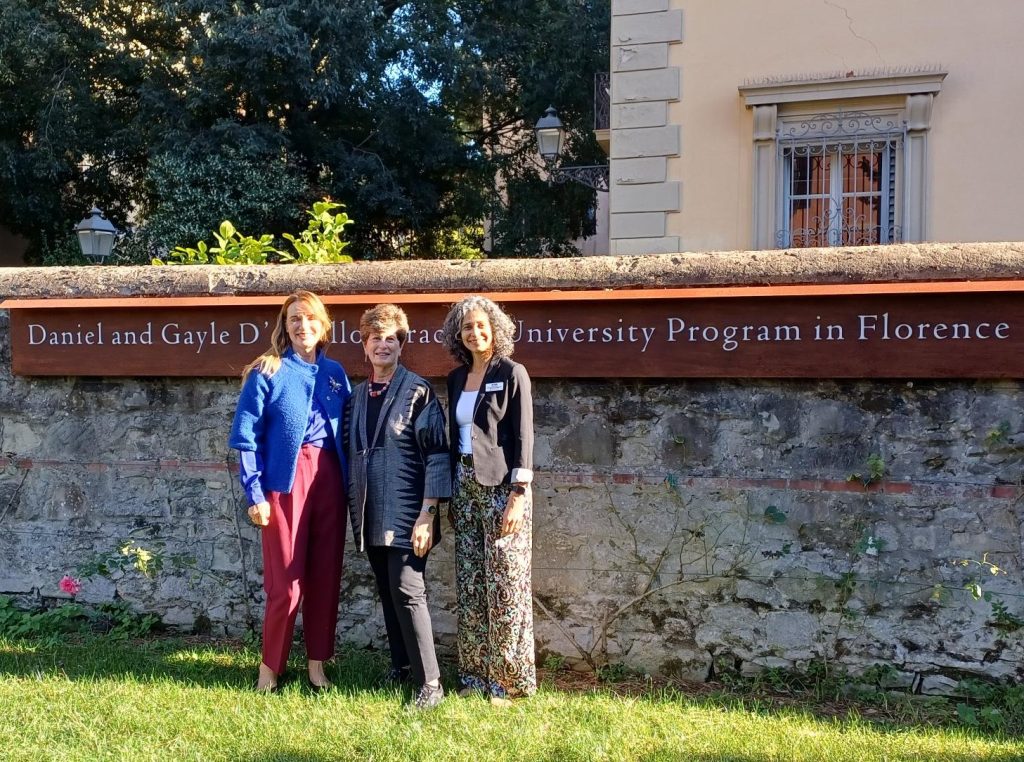
Last October, Laurie Kassman walked through the gates of Villa Rossa for the first time in six decades. As an alumna of Syracuse Florence’s fall 1966 program, she had witnessed one of the most devastating natural disasters in Italian history—the Great Flood that submerged Florence on November 4, 1966. Now, she returned to share memories of that life-changing semester.
Following in Family Footsteps
Laurie’s connection to Syracuse Florence began with her brother, who had studied there three years earlier. He had lived with a family in Fiesole and left his motorbike with Agostino, the program’s caretaker, when he departed. The bike was still in the school garage when Laurie arrived.
She lived with a host family at Viale Corsica 2—a family with two daughters whose names have faded from memory, though the experience never did. Each day, she took the bus to Villa Rossa for classes.
The Morning Everything Changed
November 4, 1966, started like any other day. Laurie waited at her usual bus stop, but the bus never came. It had been raining for four days straight, and students had just returned from fall break. Laurie herself had just come back from Rome.
As she waited, a driver stopped to tell her the buses weren’t running—the Arno had flooded. She could hardly believe it. The river had been “a piddly little stream” during what seemed like a drought, but now it had become gigantic. The driver gave her a ride to Piazza Savonarola.
When she arrived, some students were missing. Soon, the announcement came: classes were canceled due to the flood. Curious and perhaps not fully grasping the severity, Laurie and her friends decided to walk to the river to see it for themselves. “And we saw a boat coming up the road! Oh my god!”
The Aftermath: Singing While Saving History
The flood’s destruction was immense, but the response from the community was swift. Laurie’s host father, who had been a partisan, had connections to the Library of the Resistance. She joined the recovery efforts there, helping to salvage waterlogged documents. “Clotheslines were stretched out where we would hang pages to dry while singing ‘Bella Ciao,'” she recalled.
A couple of days after the disaster, the U.S. Embassy contacted the school with an urgent message: students needed to call home and let their parents know they were safe. “It hadn’t even occurred to me!” Laurie admits. “It was very sad, but we were also having this amazing adventure.”
The Journey That Started It All
Laurie’s path to Florence had begun a couple months earlier on a ship bound for Europe. She remembers Professor Jackson, “this wiry guy who jumped around to teach you Italian as though you were the child and he was the grandpa. And it worked!” The voyage lasted about a week, giving students just enough language skills to greet their host families and apologize for not speaking Italian.
The ship stopped in Lisbon, Ceuta, and Tangiers before the students disembarked in Genoa and continued to Florence. That first day in Lisbon remains vivid in Laurie’s memory. Her friends pushed her to board a city bus first. “I got on and said, ‘How much is it?’ The driver looked like my father. And some passenger said to me, ‘No speak English.’ That’s when it hit me that I was in a foreign country.”
A Life Transformed
“This experience literally changed my life,” Laurie reflects. Without coming to study for a semester in Florence, she believes she would have stayed in New York. Instead, after graduating with a degree in political science and working briefly for a magazine, she flew to Paris and never looked back.
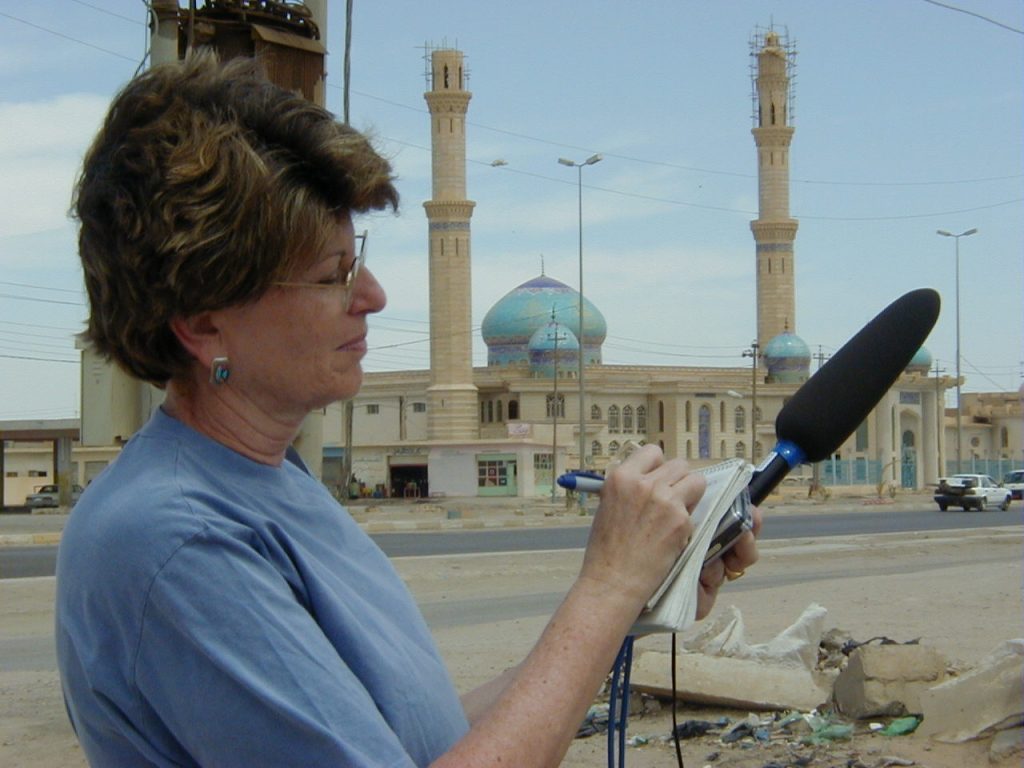
In Paris, she met Lou, a U.S.-born photojournalist, and they spent four decades traveling the world together on assignment. Their homes included Paris, Buenos Aires (arriving “at the tail end of the Dirty War”), London, and Cairo, where Laurie covered the Arab world for Voice of America. “I arrived in Cairo in June, and the Oslo Peace Process started in July,” she remembers of witnessing history unfold.
Sadly, Lou had passed away just six months before Laurie’s return to Villa Rossa. She had spent the previous month in Paris, spreading his ashes at their favorite places, fulfilling a promise they had made to each other. “I always imagined I’d marry a Frenchman and live in a château. I was kind of disappointed that didn’t happen,” she laughs, revealing the humor that carried her through decades of adventure.
Rediscovering Villa Rossa
Walking through the Syracuse Florence campus, Laurie marveled at how much the program had expanded. She didn’t remember the garden—and we confirmed that in 1966, when Countess Gigliucci still occupied the top floor of Villa Rossa, students didn’t have access to it. “OK, so I’m not crazy,” she said with relief.
The curriculum was also much more limited then. “We had political science, Italian, art history, history. Very few subjects.” But the professors left lasting impressions. Sydney Alexander, a Michelangelo expert, taught art history and would read Michelangelo’s poetry aloud. He invited students to dinner at his home in Fiesole, “where you could see Florence in the mirror of his bathroom. It opened up a whole new world to me.”
The political science professor was equally memorable for presenting a complete picture of the era, weaving together social and artistic contexts. In Room 13, Laurie recalled sitting in art history class with the lights off to view slides—always scheduled for the afternoon, after a hearty Italian lunch with her host family. “They would water down my wine, but it was rough!”
Travel was different in those days too. Laurie and her friends hitchhiked all over Italy, a common practice at the time. “You’d meet people and they’d say, ‘Let me show you this little village where I used to live…’ The good old days.”
Laurie Kassman’s return to Villa Rossa reminds us that Syracuse Florence has been shaping lives and opening horizons for generations of students—even those who arrived just in time to witness history.