News Archive

Breaking Barriers in the 1960s: The Story of Garland Jeffreys, Syracuse Florence’s First Black Student

In the early 1960s, Garland Jeffreys became what is believed to be the first Black student at Syracuse Florence. That semester would prove transformative for the young man from Brooklyn, who later became a celebrated rock and soul musician—collaborating with legends like Lou Reed, writing songs covered by everyone from Rickie Lee Jones to John Mellencamp, and creating music that boldly addressed racial identity and urban life. His 1977 song “Wild in the Streets” became an anthem, and over a career spanning decades, he released critically acclaimed albums that blended rock, reggae, and soul while never shying away from confronting social issues.

Fellow Syracuse alumnus Martin Inn, Garland’s friend from that pioneering semester, brought Garland’s remarkable story to our attention. Inn had a similar experience as one of the first Asian Americans to attend Syracuse Florence, and he shared his wonderful story with us in the last printed issue of the Villa Rossa Voice (page 10). He also provided the black-and-white photo above of Garland with his host family, “taken at Via Benedetto da Maiano in Fiesole where we lived,” he explains.  “Garland had the same family as me probably because they were Italian Communist and were accepting of people who were not white. They were wonderful people and we loved them.”

Today, Garland is living with late-stage Alzheimer’s and can no longer share his stories himself. But his wife Claire Jeffreys—who produced the 2023 documentary Garland Jeffreys: The King of In Between, now streaming on Amazon Prime, Apple TV, YouTube TV, and Tubi—spoke with us about Garland’s time in Florence, what the experience meant to him, and why he kept returning to the city he loved.

What has Garland told you about the time he studied at the Syracuse program in Florence?

Garland always spoke of his time in Florence with great enthusiasm and excitement. He said not many people from his neighborhood made it to Florence to study. He especially loved his host families and loved the home cooking with lunch every day. One of his Brooklyn friends said he came home with a round face from all that pasta! He spoke of being with the host family when Kennedy was murdered and hearing cries of “Kennedy è morto!”

Can you confirm whether he was the first Black person to attend the program, as claimed by his friend Martin Inn?

This is what I was told but I can’t confirm 100%. Garland said he went to the director of the program (or perhaps a professor) and argued forcefully that the reason he had been rejected from the program was because he was Black, and that they then reconsidered and allowed him to attend. 

In the story he shared with us, Martin mentioned that Garland returned to Florence after having studied here. Do you know more about that? Did he ever come back to Florence with you?

He remained in love with Florence! We went back together many times, including our first trip (and my first) to Europe together in 1981. He took me to the Bargello Museum and showed me the Cellini statues, to the Uffizi, and to Fiesole, all the time using his art history knowledge to impress me! We visited his friend Piero Colacicchi, who later taught at the Accademia and had a family villa in Fiesole.

Claire and Garland with daughter Savannah (from Garland Jeffreys)

Garland was an art history major while he was here and then attended grad school in NY before dropping out to go into music. What was his favorite period? Did this interest in art history ever pop up later in life?

He was most interested in the art of the Renaissance. He loved to go to museums and look at paintings and that remained a constant throughout his life, though it never became a focus of his lyrics. One of his favorite painters was Giorgione. He also loved the frescoes of Fra Angelico and the paintings of Duccio.

What kind of advice do you think Garland might have had for students of color on a semester abroad today?

Never feel like you don’t belong. By nature of being there, you belong. See as much as you can see, don’t hold back on going out or taking day trips, because that precious time can never be duplicated. Talk to everyone you can! Let your horizons expand!

Florence Alumna Publishes Research on Counterfeit Fashion and Hip-Hop Culture

Jacquelyn Trotman, a Syracuse University student who studied in Florence last spring, has achieved a notable academic milestone with the publication of a paper in the Syracuse Honors Research Journal: “Dapper Dreams: Gucci and the American Hip Hop Scene, 1980s-1990s.”

Trotman’s paper originated as a final project for Professor Chiara Faggella’s course DES 300.2 (Bellissima! Unraveling the Threads of Italian Fashion) in April 2025. Her research explored the intersection of counterfeit Italian luxury fashion goods and the American hip-hop scene during the 1980s and 1990s, examining how these unauthorized reproductions were repurposed and given new cultural meaning.

“Jacquelyn wrote a brilliant paper based on research she conducted autonomously,” said Professor Faggella. “She really did an amazing job and shed light on a brilliant case study.”

After completing the course, Trotman refined her work and submitted it to the research journal run by the Renee Crown University Honors Program, with Professor Faggella serving as her supporting faculty member.

Trotman’s achievement shows how the Florence program can spark academic inquiry that extends beyond the semester abroad, turning classroom assignments into published research that contributes to broader scholarly conversations about fashion, culture, and identity.

Saints, Scholars, and Pizza: Graduate Students Launch Florence Experience

On January 20, the six graduate students who recently arrived at our campus for their year-long residency in Florence, all members of the 2026 cohort of master’s degree candidates in Italian Renaissance Art, attended a special lecture at the Villa Rossa by Alison Fleming, professor of art history at Winston-Salem State University.

In her lecture, “Saints and the Power of Images in Early Modern Catholic Florence,” professor Fleming explored the fascinating and often competing roles that images, economic history, and social levers played in the complex path to canonization for three Florentine saints in the 17th century: Sant’Andrea Corsini, Santa Maria Maddalena de’ Pazzi, and San Filippo Benizi.

The lecture, which was also attended by a number of Villa Rossa faculty members, included a lively discussion between the graduate students and professor Fleming, who is herself an alumna of our MA program, followed by a collegial pizza dinner in piazza Savonarola.

Professor Chiara Faggella Presents Book on Fashion History

In November, Professor Chiara Faggella, who teaches Italian Fashion and Food Stories and the design course Bellissima! Unraveling the Threads of Italian Fashion, was invited to be featured at an event at the Accent Global Learning Florence Study Center to present her book, Becoming Couture: The Italian Fashion Industry after the Second World War, published by Manchester University Press. The roundtable was organized as a joint collaboration between Università degli Studi di Firenze and Accent Global Learning.

Using Faggella’s book as a starting point, the participants – Isabella Martini (University of Florence, moderator), Mariarosa Mettifogo (Accent Global Learning), Fabio Corsini, Dafne Mazzanti, and Francesca Passeri (Accent Global Learning) – and Faggella discussed how Italy’s postwar fashion industry evolved into the global powerhouse we know today. 

Among the many topics covered they tackled the role of celebrity culture and cinema in advancing the cause of Italian style in postwar years, but also the role of professional intermediaries that work behind the scenes and aid the more famous designers in creating their signature looks, ending with a lively debate the effectiveness of the label Made in Italy today and how to best help our international students understand the specificities of the Italian fashion system, between past and present.

Two Nights, One Celebration:  Fall ’25 Student Exhibitions  

Studio Art Student Exhibition

Syracuse Florence closed the semester with two vibrant nights on December 11–12, when the community gathered for the Fall ’25 Final Art and Architecture Exhibitions. The turnout and enthusiasm transformed the event from a semester wrap-up into a moment of real recognition for the work—and people—behind it. 

Architecture Student Exhibition

The exhibitions brought together outstanding work from Studio Arts, SRISA, and the Architecture program, reflecting months of sustained effort and refinement. Across the displays, visitors encountered bold ideas, compelling imagery, and a level of craftsmanship that spoke to both technical growth and creative confidence.

From handmade metal jewelry to intricate architectural sketches, and from experimental studies to a wall fresco executed with traditional techniques, the range of media and approaches underscored the strength and ambition of this year’s cohort. Seeing these projects fully realized—carefully installed, thoughtfully presented, and confidently discussed—was a powerful moment for the entire community. 

SRISA Student Exhibition Fall 25

The celebration also carried a special note of gratitude as we honored Stefania Talini on the occasion of her retirement. The tribute was moving and joyful in equal measure: a gathering filled with memories, affection, and sincere appreciation for the impact of a dedicated educator. Director Sasha Perugini marked the occasion with heartfelt remarks, recognizing Stefania’s years of commitment and the lasting influence she has had on generations of students. 

For a closer look at the highlights, explore the beautiful photographs by Francesco Guazzelli, which capture the energy of the evenings and the remarkable achievements on display. 

By Martina Daniele

Florence Graduate Program Celebrates Record Cohort at 39th Annual Symposium 

39 Graduate Symposium-0

On December 5, 2025, the Florence Graduate Program in Italian Renaissance Art hosted its 39th Annual Symposium, welcoming a virtually standing-room-only audience to Villa Rossa’s Room 13 to hear the largest M.A. cohort in the program’s history present their capstone research. The event highlighted not only the caliber of student work, but also the program’s defining strength: Florence is not a setting for study; it is the site of study. 

As one of the College of Arts and Sciences’ signature programs, the Florence Program offers an M.A. in Art History through an immersive experience in Italy that is difficult to replicate anywhere else. Students don’t learn about the Renaissance at a distance; they study it where it was made, with direct access to artworks, architecture, and the documentary and conservation infrastructures that sustain the field. Working in and beyond Florence, candidates develop the practices of professional art historians—close looking, archival research, and persuasive public presentation—while engaging a community of recognized scholars, conservators, curators, and research institutes. 

That is why the experience is so transformative. Supported by a rigorous curriculum and close mentorship, students graduate with the skills to pursue a wide range of careers, producing original research that makes substantive contributions to Renaissance studies. 

This year’s symposium also underscored the program’s continuity across generations with the visit of Professor Eric Frank and Penni Montalbano (both alumni, 1976). Frank, a longtime art history professor at Occidental College, had the opportunity to reconnect with Oxy alumni including Jennifer Cowden and Sean Nelson, who now teaches the program’s graduate seminar “Mapping a Global Renaissance.”  

With capstone presentations ranging from women’s art-historical biography and Medici-era politics to diplomatic ritual and devotional imagery, the symposium made clear why the Florence Program endures: it reshapes how students look, how they research, and how they speak as scholars. The symposium is the public culmination of that transformation—proof that the Renaissance holds “always more to say,” and that Florence remains one of the best places in the world to learn how to say it. 

By Martina Daniele

From Florence with Heart: Students Lead Inspiring Volunteer Milestones

This fall semester at Syracuse Florence marked an exciting turning point for our volunteer program. Under the guidance of Olimpia Bozza, the program has been revived and expanded, becoming more active than it has been in several years. The renewed structure has opened the door to new opportunities, stronger community partnerships, and a wave of student initiatives.

Student Journalism

One new and successful volunteer opportunity was the student reporter position for this very news page. Wake Forest communication major Jacqueline Money David provided enormous help in creating content with her talented writing. This experience demonstrated the value of student-led journalism, and we hope more students will want to volunteer for this role in future semesters.

Charity Fundraising

Another runaway success was the charity fundraising organized by Eliza Duff-Wender, who volunteered with Fondazione Solidarietà Caritas ETS. Duff-Wender committed to supporting their soup kitchens, which provide more than 1,200 meals each day to people in need across Florence.

“It was especially important to me that I not only reap the benefits of living here in Florence, but also that I be intentional with my time here,” Duff-Wender said.

As part of her experience, Duff-Wender launched a creative fundraising initiative mobilizing fellow study abroad students to reflect on their spending habits and give back to the city that has hosted them. She not only met but surpassed her fundraising goal, and she even shared her story in a podcast—in Italian—recorded with Radio Toscana, helping raise awareness among other international students.

“We are very grateful to Eliza for her work and dedication and proud of the meaningful impact created through our I-Engage program,” said Syracuse Florence Director Sasha Perugini. “Writing this as a Florence citizen, grazie!“

Food Bank Volunteers

Another impactful example of volunteer opportunities has been the charity and donation drives organized by student volunteers connected to the St. James Food Bank. Volunteers Annie Carter and Sophia Claps worked together every Thursday morning, stocking the food pantry, putting together bags of food, sorting clothing, and handing out fruit.

“I really enjoyed my role at St. James because I was able to meet local people in the Florence community while also helping those in need,” Carter said. “This experience also helped to fill some of my free time during the early weeks of study abroad, giving me an added sense of purpose.”

Claps shared similar sentiments about the experience. “I enjoyed meeting the other regular volunteers and learning about their experience with how they ended up living in Florence,” she said. “Seeing the same faces from the community every week was very special when they came to collect goods.”

Carter and Claps extended their volunteering into Syracuse Florence by hosting a donation drive for clothing, bedding, towels, food, and toiletries that study abroad students might leave behind at the end of the semester.

“I would totally recommend this volunteer opportunity to future students!” Carter said.

The revival of the volunteer program has empowered students to connect more deeply with Florence while supporting meaningful local causes, turning everyday moments into opportunities for service and sustainability.

Syracuse Student Gains International Journalism Experience at Florence Magazine

Syracuse University journalism major Jack Siciliano recently completed an internship with FUL (Florence Urban Lifestyle) Magazine, gaining valuable international work experience while combining his passion for journalism with his interest in Italian language and culture.

During his time at FUL, Siciliano contributed directly to the magazine’s editorial output, publishing original articles under his own byline and supporting the translation and editing of content for both print and online editions. His independent reporting included research-based articles on football culture and stadiums across Tuscany, allowing him to explore Florence beyond its tourist image and engage with the city’s contemporary cultural dynamics.

“Working for FUL Magazine was an amazing opportunity to combine my interests in journalism and Italian,” Siciliano said. “They really care about the quality of their work at FUL and that was a great environment to be a part of.”

The internship provided Siciliano with hands-on experience in how local journalism can critically interpret place, identity, and community. FUL Magazine’s editorial approach presents Florence not as a static tourist destination but as a living, evolving city shaped by contemporary cultural, social, and urban dynamics.

Francesco Sani, Editor of FUL Magazine, emphasized the mutual benefits of hosting Syracuse students. “We are very interested in the cultural exchange that has developed through hosting students from Syracuse University,” Sani said. “The experience of an independent magazine like ours stems from the desire to give a voice to Italian and foreign talents who have always lived in Florence or are just passing through!”

According to Internship Coordinator Olimpia Bozza, the partnership exemplifies the goals of experiential learning. “Our partnership with Firenze Urban Lifestyle Magazine offered a particularly strong learning opportunity for the student placed there this semester,” Bozza said. “It allowed him to combine fieldwork, cultural analysis, and journalistic writing in a way that aligns well with the goals of experiential learning.”

Bozza noted that FUL demonstrated itself to be a flexible and thoughtful partner capable of supporting a non-traditional internship structure with meaningful professional outcomes, offering Siciliano the chance to gain insight into how journalism operates in an international context while building his professional portfolio.

Check out the article Jack published in FUL:

Pisa-Fiorentina, torna in Serie A il derby eterno – FUL Magazine

Cracked Concrete and Faded Glory: The Decline of Tuscan Stadiums – FUL Magazine

Local Students, Global Perspectives: Interning at Syracuse Florence

Two Florentine university students, Lapo and Edoardo, are spending the semester supporting Syracuse Florence as interns while engaging with academic life in an international setting. Both are in their final year of Political Science programs with a concentration in International Studies and saw the internship as a chance for them to immerse themselves in an American academic environment.

Lapo, who is currently writing a thesis on the U.S. arctic strategy in Greenland, was drawn to the opportunity to work in an international setting. He noted that, “being in an American university environment allows me to better understand how this educational model works in practice. Working with colleagues from different countries and professional backgrounds helps me develop my communication skills, my ability to work in a team, and my understanding of different work cultures.”

Much of Lapo’s work happens in the library office, along with supporting student internship coordination and other administrative projects. What he values most is the intercultural exchange: “Talking with American students, including graduate students, allows me to listen to and learn how other young people are building their academic paths and planning their future careers. This constant exchange helps me broaden my own outlook.”


Edoardo shared a similar motivation. His interest in history and geography as well as the chance to explore an international setting led him to explore opportunities outside of the traditional Italian university setting. Like Lapo, he works primarily in the library office at Syracuse Florence, while dividing his time across various offices and supporting whenever need. For him, “the most rewarding part is being in a healthy and stimulating environment, where there’s a nice relationship between students and staff with everybody being kind and helpful.”

Edoardo also has an interesting connection to the history of Syracuse Florence, since his grandparents knew Countess Bona, the original owner of the Villa Rossa.

They both highlighted noticeable differences between U.S. and Italian university systems, especially the smaller class sizes, close student-faculty relationships, and emphasis on student participation at Syracuse Florence. While recognizing the strengths and weaknesses of both systems, they shared how their exposure to a different academic culture is shaping their personal and professional growth.

Both Lapo and Edoardo are considering careers in diplomacy; whether they continue in academia, public service, or international work, they see their internships as a guiding step. For Syracuse Florence, their contributions represent local engagement that brings students within the city to a setting that can bridge various cultures.

By Jacqueline Monet David (Wake Forest University)

A Passage to Sicily: Students Discover Archaeology through Experience and Insight

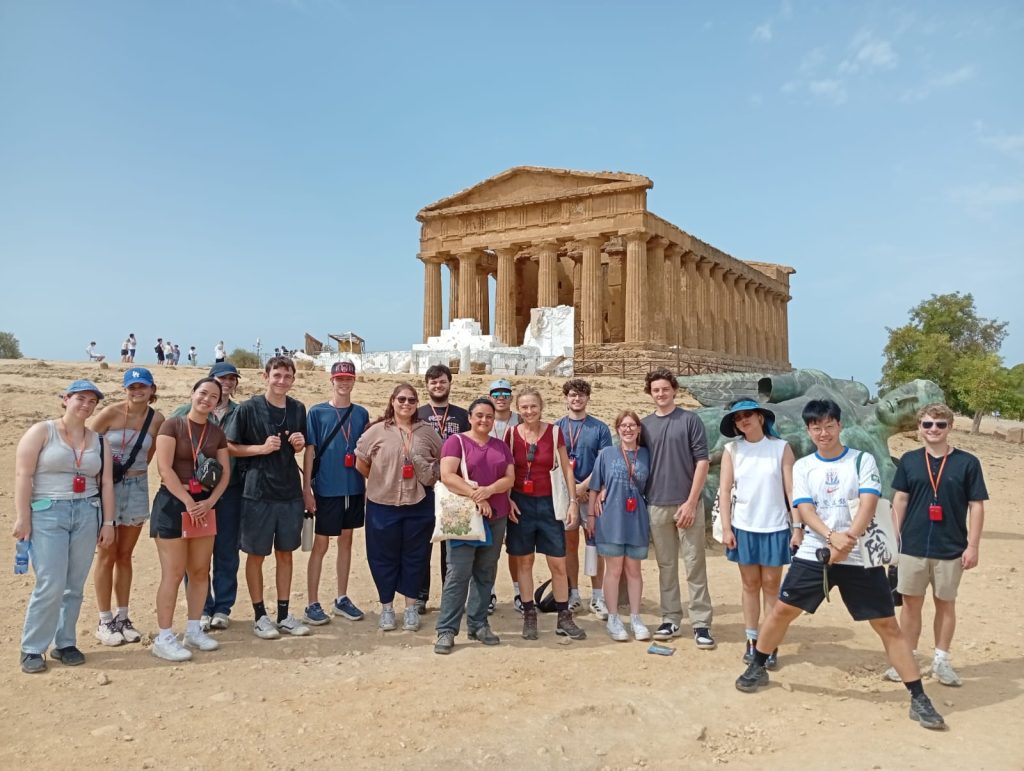
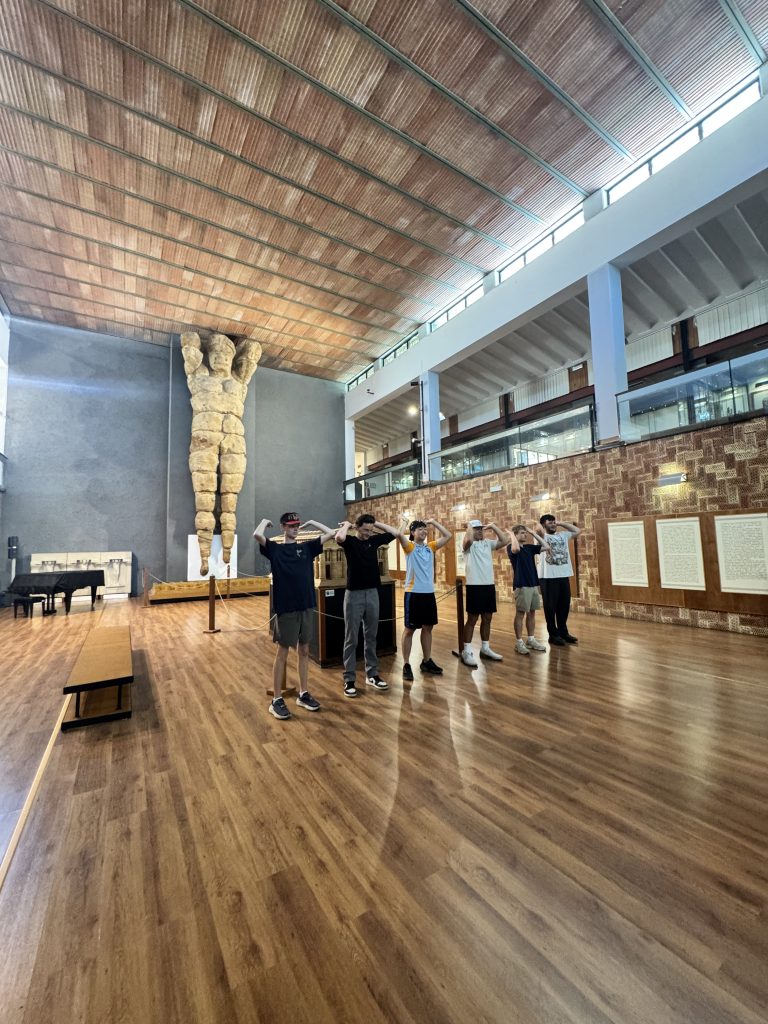
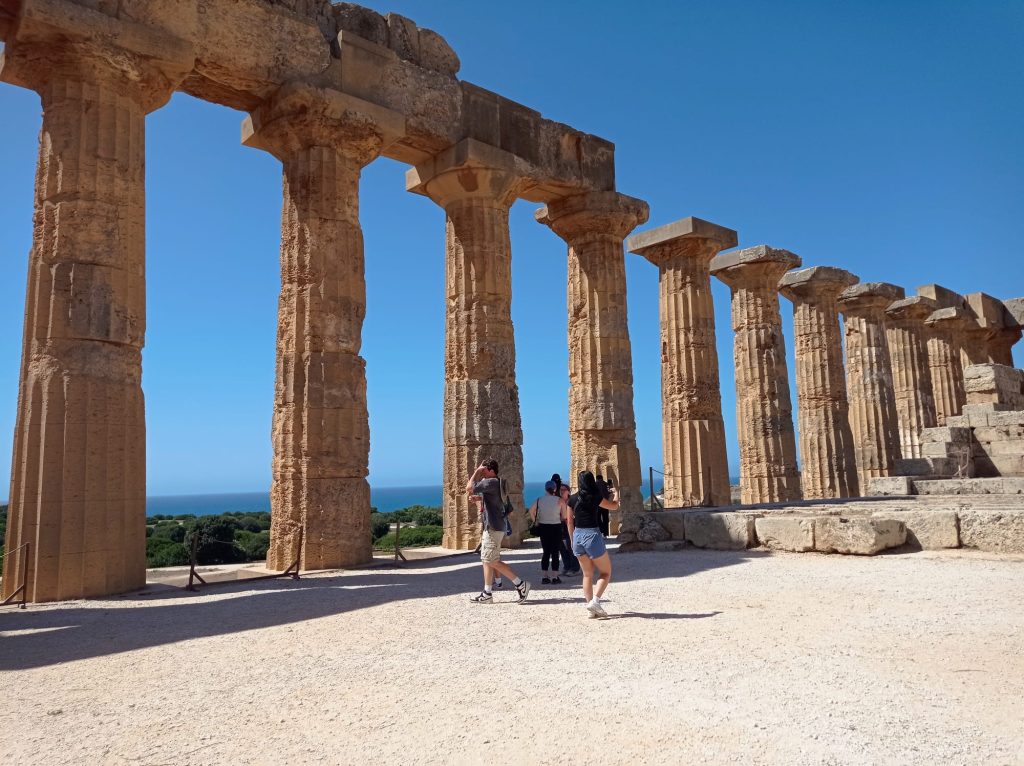
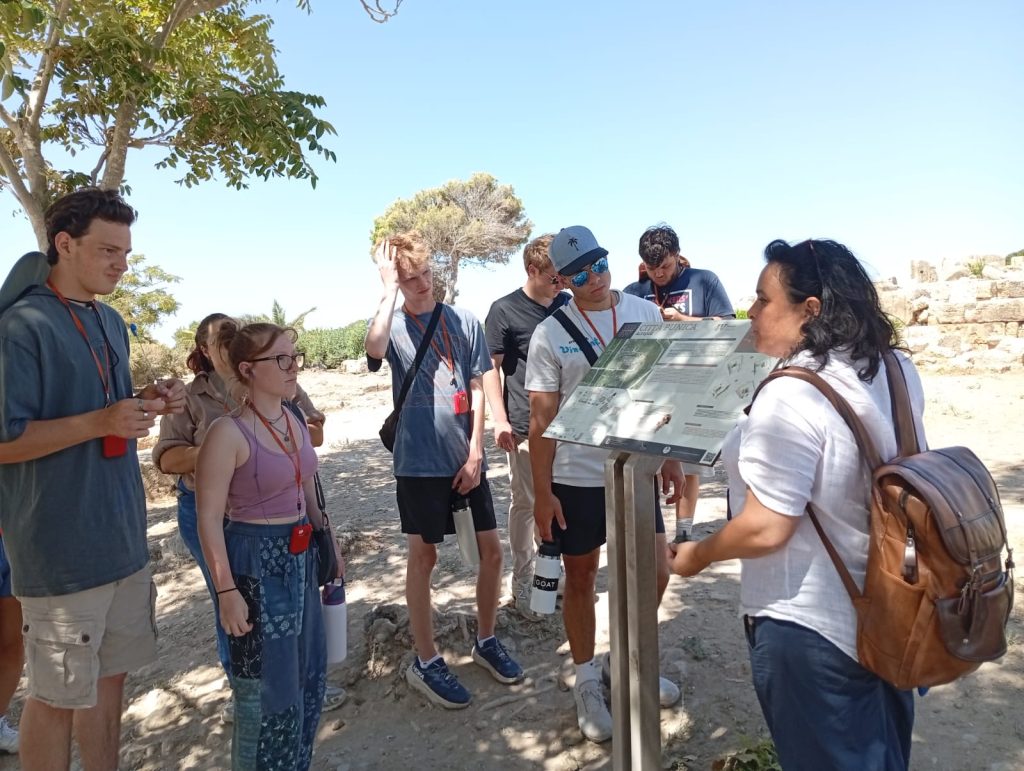
This is a brief account of the Signature Seminar “Hands on History in Sicily” that I led from August 24 to September 2. The purpose was to introduce students to the multifaceted work of archaeologists while touring one of the most beautiful regions of Italy and encountering the rich, millenary culture of the cities we visited.

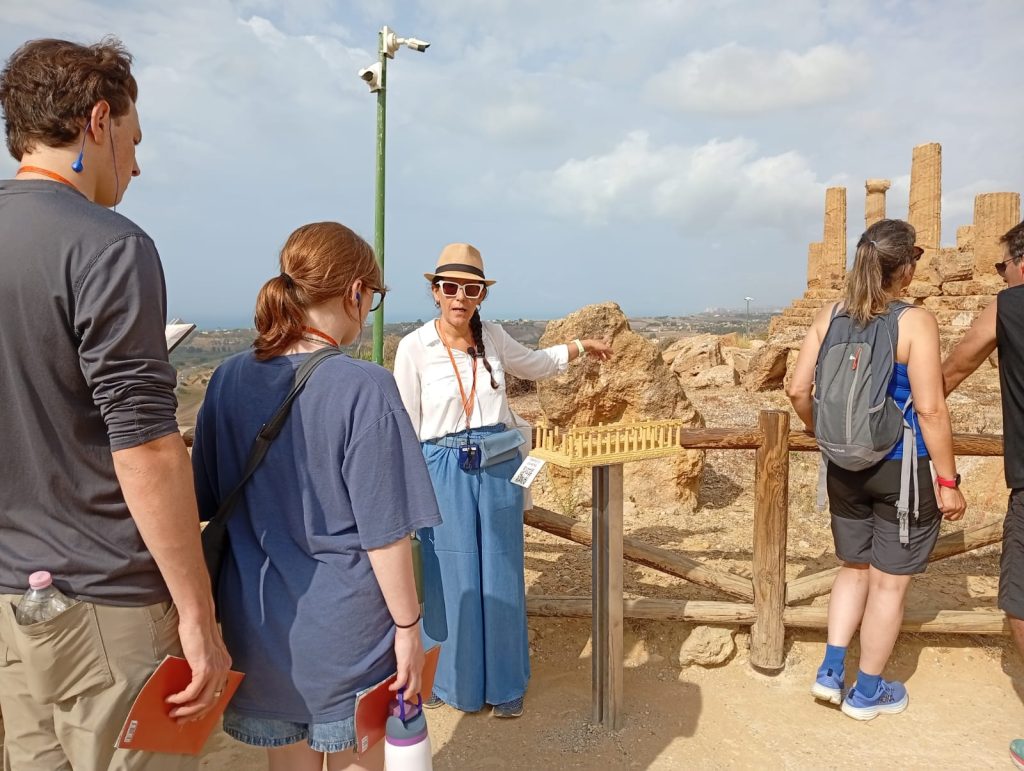
The seminar was supported by a network of academics, freelance archaeologists, and tour guides who successfully conveyed how varied the work of an archaeologist can be: from setting up an urban didactical excavation; to harmonizing research on the groundbreaking findings of a remote town in the Nebridi mountains with the efforts of local administrators to promote the area’s culture; to the daily struggles of a tour guide who needs to update and implement tours of a well-known place like the Valley of the Temples in Agrigento; to the human touch of people and local bodies that want to give back to the community by transforming history into investment opportunities.

The task was not easy, especially because our group of fifteen students landed in Florence on a Saturday and left for Sicily the very next day! They had no time to adjust to the climate and culture first – it was a full immersion experience from day one. I was blessed with a group of young adults who were very interested in the topics and activities involved. I also benefited greatly from the help of the Responsible Adult assigned to the trip: Prof. Giulia Pettena, a colleague, friend, and fellow archaeologist who was ready to fill in whenever a student needed more explanation or still had questions after I had already moved on to the next monument or subject.

This seminar was one of a kind. Although there are different archaeological projects in Italy involving foreign students and many field trips for study abroad students to visit sites and museums, our seminar is the first to blend hands-on experience with in-class lectures and on-site visits in different locations for students without prior experience in any of the subjects to be covered.

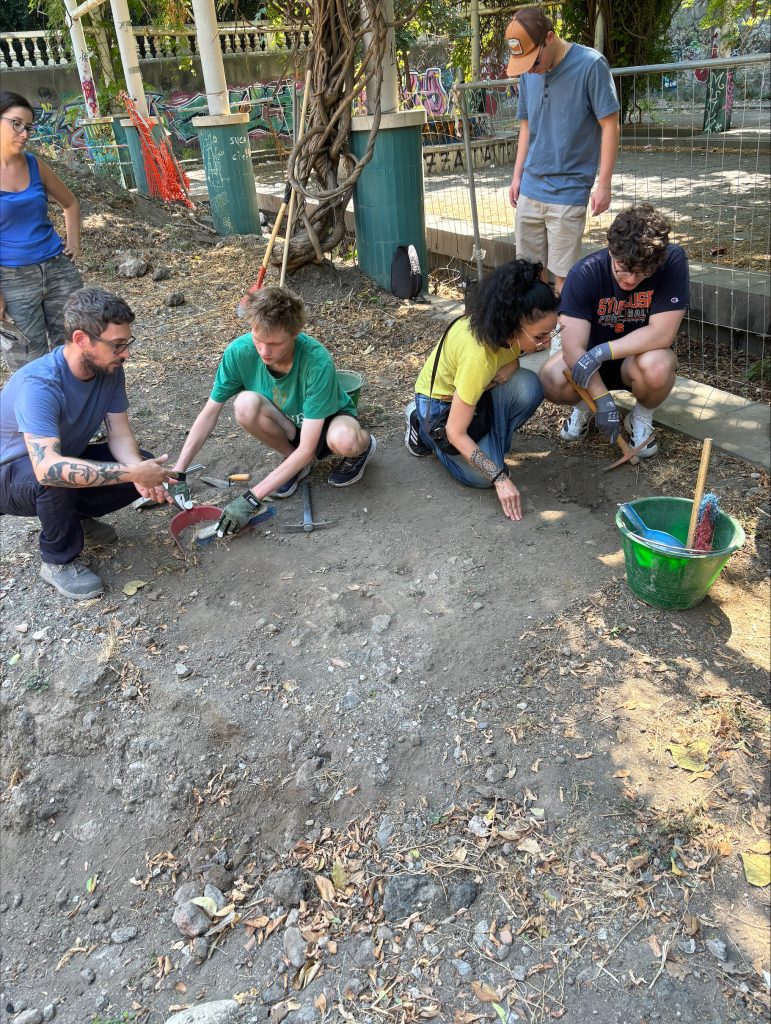
Our journey started in Catania where we were welcomed by the fascinating lava stone used for the city’s ancient and new buildings and roads, while the ongoing eruptions of Mount Etna gave us breathtaking shows at night! My contact there was Prof. Simona Todaro, who teaches the prehistorical and proto-historical archaeology of the islands Sicily, Malta, and Sardinia and leads a didactical excavation in the courtyard of a former Benedictine Monastery. Her energy and professionalism captured the souls of our students, who cited their experience with her in their journals and final papers more than anyone else.

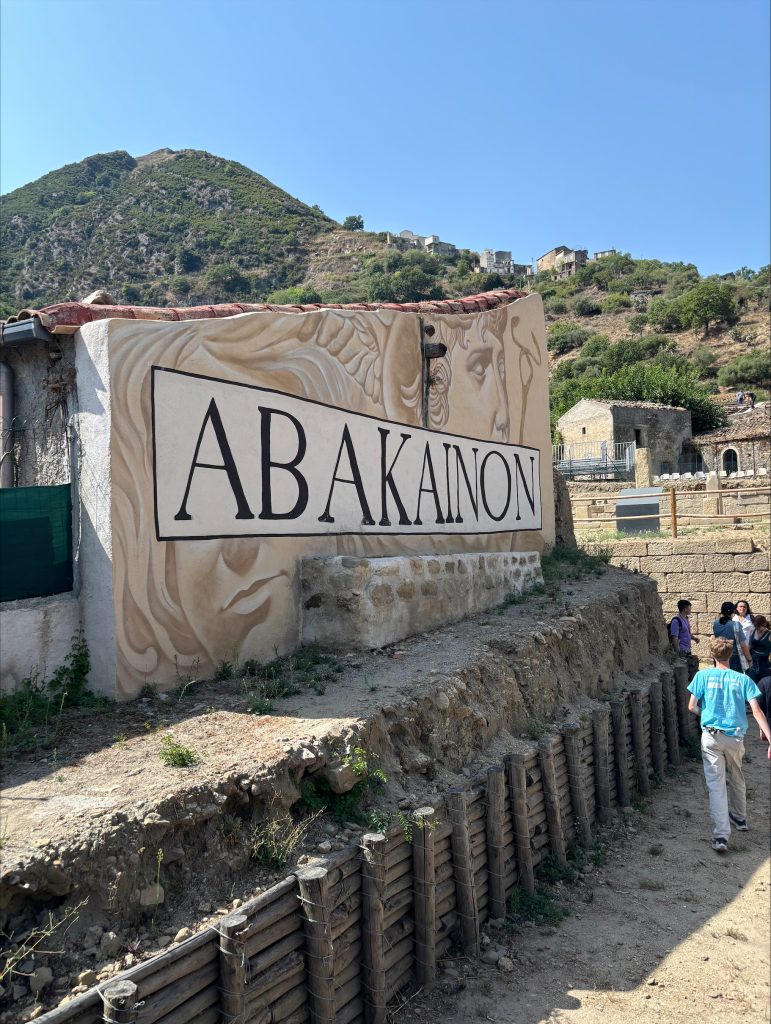
The newness of the project in the small town of Tripi, in the province of Messina, added to our adventure. We made connections between past and present as we explored excavations and a museum that have only recently opened to the public. The initiatives of the town’s mayor were obvious. Its full, official name is Tripi-Abakainon, which combines the modern and ancient ways to refer to the settlement, and its three neighborhoods feature modern murals referring to ancient objects and deities tied to the Siculo-Greek town.

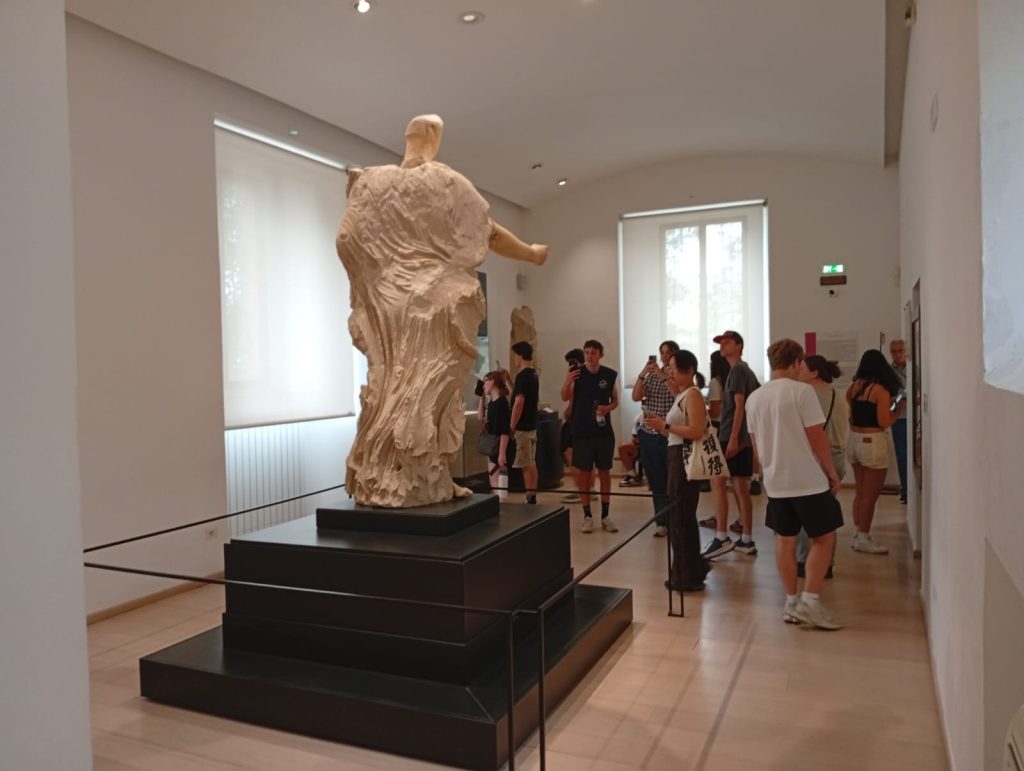
On our way to Agrigento, we stopped in Aidone where over the past twenty years objects have been restituted to the local museum, including the acroliths of Demeter and Kore (the oldest acroliths ever discovered); the so-called Aphrodite of Morgantina; the silver treasure of an ancient private house in Morgantina; and the so-called Bluebeard of Morgantina. This stop gave us a chance to discuss the delicate topic of tomb robbers and the illegal art market, since the Getty Museum in Malibu and the Met in New York have been targets of an international investigation of stolen artifacts.

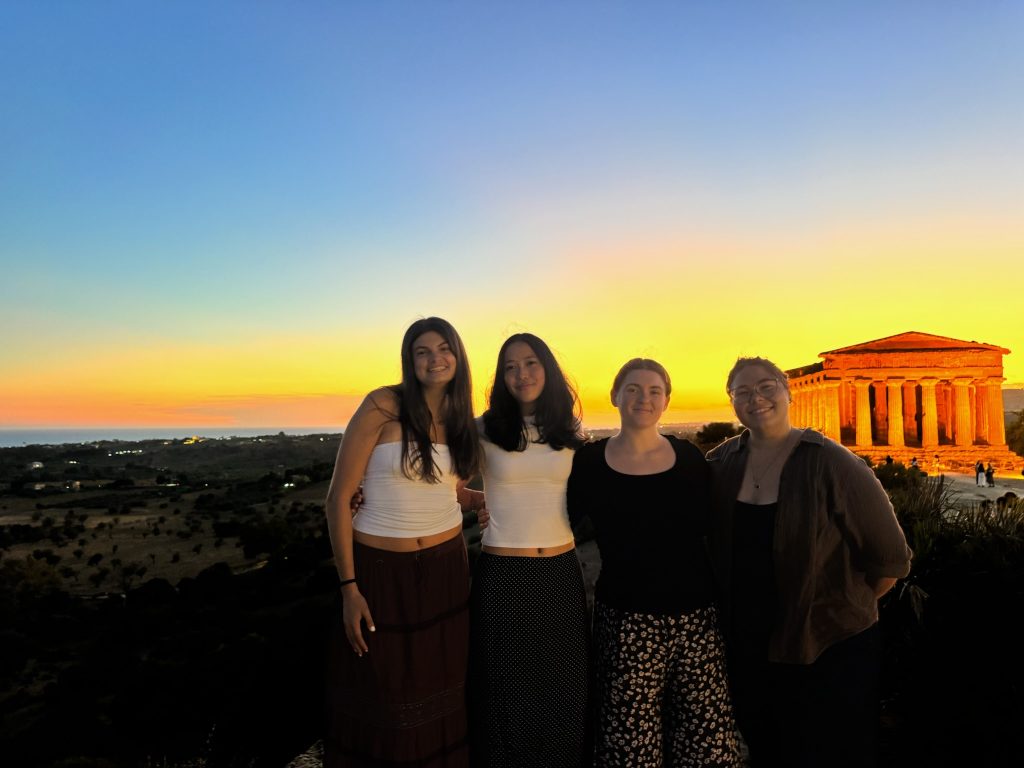
In Agrigento, the students worked on a special project that I developed with archaeologist and tour guide Laura Danile in which they split up into three groups to plan a visit for three different users: families with children; people who walk with difficulty; and English speakers. Our two-day visit to the site with Laura was crowned by the unforgettable experience of wandering around the temples at sunset. During our stay, we also enjoyed two unique experiences: lunch in the Kolymbetra garden, where we met its visionary creator, and a visit to Casa Diodoros, a biodiversity-focused enterprise preserving local traditions and species like the Girgentana goat.

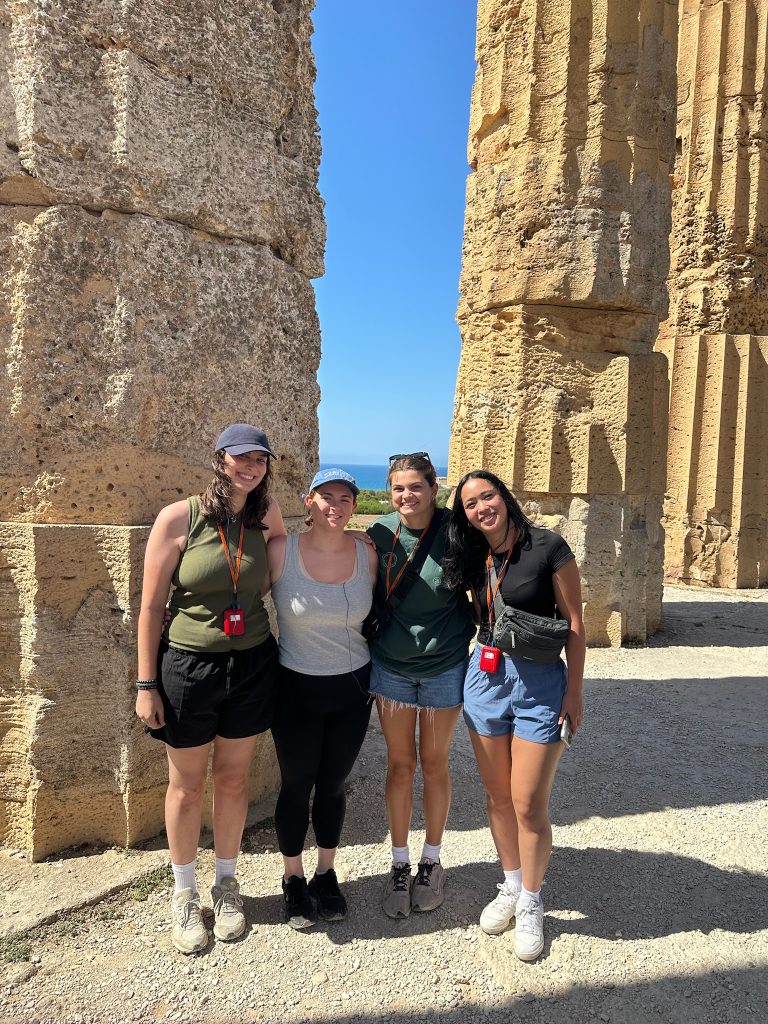
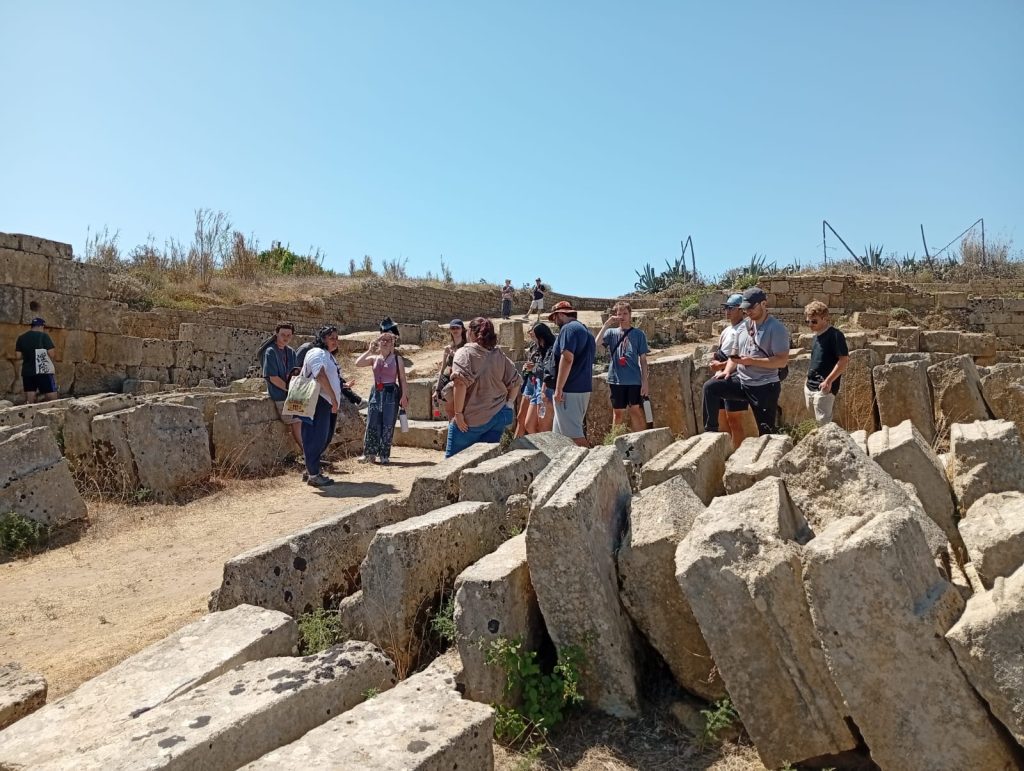
Our last stops were in Selinunte and Palermo where the students surprised us. It had not been an easy trip – every day required immense focus and stamina – and students complained about the lack of free water. Yet during their free time on their last day, they chose to visit Palermo cathedral and savor a final taste of local history and art!

I cannot explain how grateful I am: to the students, to Sasha Perugini and Rachael Smith for believing in my idea for this seminar, and of course to all the office staff at the office for structuring and supporting the logistics of the journey. I am grateful from a human side, but also from an academic perspective, since the experience had a powerful impact on our students. It was emotional to watch them widen their eyes and smile not just in front of a beautiful marble statue, but also while absorbing the passion of someone explaining how ancient history remains relevant today.

I believe that the study of ancient cultures through their stories (myths) and their daily life (archaeology) is the ultimate way to dialogue with our ancestors. Who knows how much help that dialogue can bring to us in our struggle to find a new kind of humanity in our society.

But don’t just take it from me:

One of the most valuable aspects was the excavations … all I found was a small piece of plastered pottery, [but] it was a massive find to me. It allowed me … to understand the pride of finding these items. … This trip also exposed me to more culture than I was expecting. J.A.

I began to understand archaeology in a broader way. It is not only about collecting artifacts but also about reading the soil, analyzing stratigraphy, and noticing how structures evolve over time. This approach felt almost poetic. C.W.

I really enjoyed being able to get hands-on experience. … what stood out most to me was the opportunity to experience history in a way that felt tangible and immediate. It is one thing to read about temples, necropolises, or ancient cities in a textbook, but it is an entirely different experience to walk among the ruins, see the scale of the structures, and imagine the lives of the people who once inhabited those spaces. J.C.

By Professor Stefania Berutti